
For hotel, resort, villa and serviced apartment projects, choosing a shower cubicle is not only about selecting a bathroom product. It affects the guest experience, maintenance cost, interior design value and long-term operation of the property.
That is why many architects, contractors and hotel developers compare Stainless Steel Shower Cubicle vs Aluminum Shower Cubicle before placing an order. Both materials can work well, but they serve different project needs.
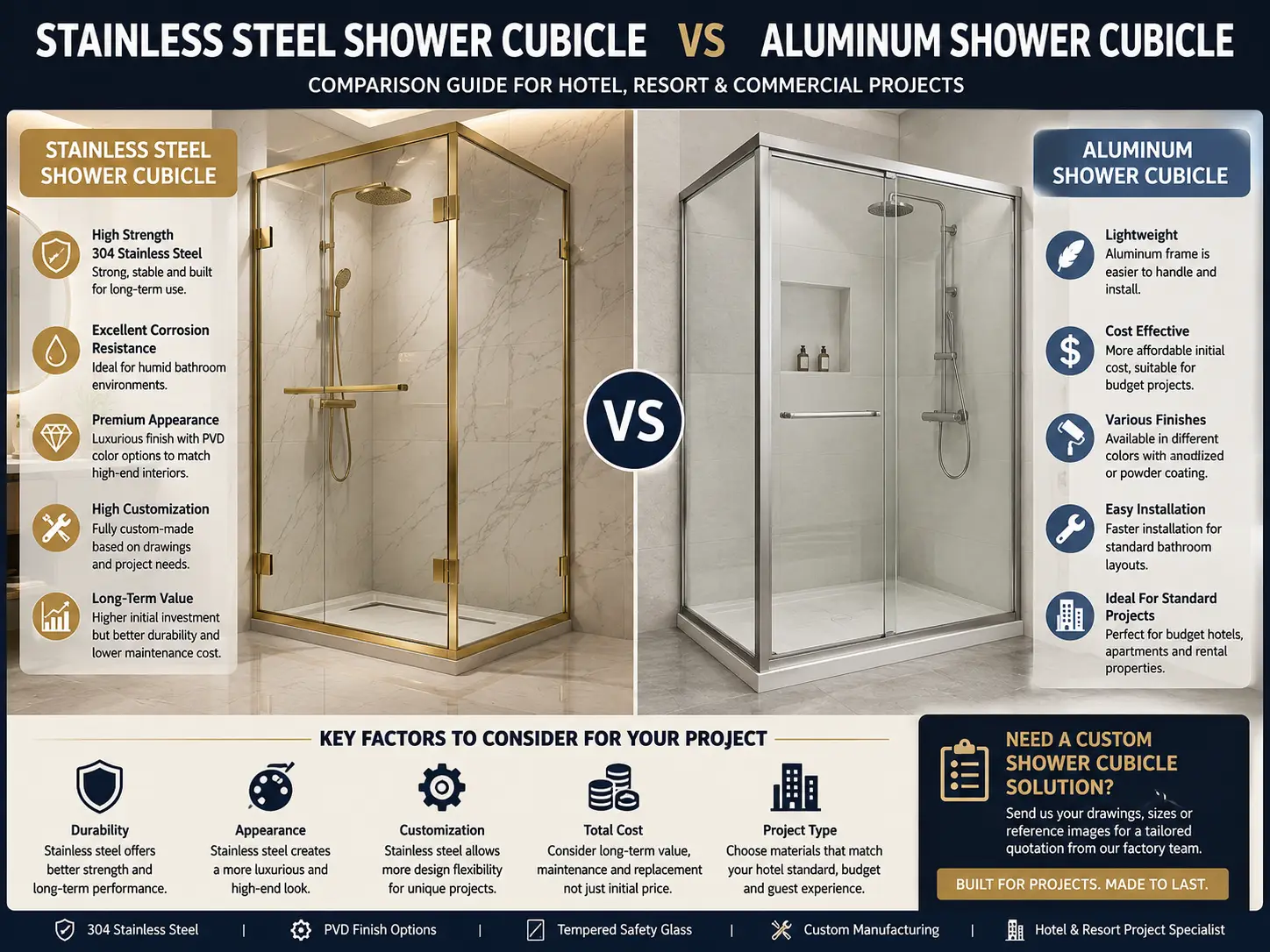
A stainless steel shower cubicle usually gives a stronger and more premium feeling. An aluminum shower cubicle is often lighter, easier to source and more cost-friendly. The better choice depends on budget, room category, finish requirement, bathroom layout and how the project will be used after handover.
This guide explains the practical differences from a B2B project point of view, especially for hotels, resorts, villas, apartments, interior contractors and bathroom solution distributors.
What Is a Stainless Steel Shower Cubicle?
A stainless steel shower cubicle is a shower enclosure system that uses stainless steel for the main frame, hardware or decorative structural parts. It is usually combined with tempered glass and customized accessories to create a complete bathroom enclosure.

In project work, a stainless steel shower enclosure is not only a simple shower door. It can be designed based on drawings, room types, glass sizes, bathroom layouts and finish requirements.
A typical stainless steel shower cubicle may include:
- Stainless steel frame or profile.
- Tempered glass panel.
- Stainless steel hinges.
- Stainless steel handles.
- Sliding rail or top rail system.
- Water seal and magnetic strip.
- Fixing accessories.
- PVD stainless steel finish.
- Custom floor or wall fixing details.
For many hotel bathroom shower cubicle projects, stainless steel is selected because it can create a stronger, cleaner and more luxurious metal detail. It is commonly used in:
- Hotels.
- Resorts.
- Villas.
- Luxury apartments.
- Serviced apartments.
- High-end bathroom projects.
- Custom architectural projects.
A 304 stainless steel shower frame is often requested for interior bathroom projects. In some special environments, buyers may also ask about 316 stainless steel. The right grade should be confirmed according to project location, humidity level, cleaning chemicals, budget and expected finish.
What Is an Aluminum Shower Cubicle?
An aluminum shower cubicle is a shower enclosure system that uses aluminum profiles as the main frame. It is widely used in residential bathrooms, apartments, budget hotels and projects where cost control is important.
An aluminum shower enclosure can be practical, clean and easy to install when the profile system, surface treatment and hardware quality are properly selected.
A typical aluminum shower cubicle may include:
- Aluminum shower frame.
- Tempered glass panel.
- Aluminum profile system.
- Hinges or rollers.
- Handle set.
- Water seal.
- Wall fixing accessories.
- Anodized or powder-coated surface finish.
Aluminum is often chosen because it is lightweight and cost-effective. It can be suitable for:
- Budget hotels.
- Standard apartments.
- Rental properties.
- Projects that need strict cost control.
- Standard bathrooms without a high-end metal design requirement.
For many standard bathroom projects, an aluminum shower cubicle can be a reasonable choice. The key is to check profile thickness, surface treatment, roller quality, installation method and after-sales maintenance.
Stainless Steel Shower Cubicle vs Aluminum Shower Cubicle: Quick Comparison Table
The table below gives a quick project-level comparison. It is useful for architects, contractors, developers and purchasing teams who need to shortlist materials before asking for a quotation.
| Criteria | Stainless Steel Shower Cubicle | Aluminum Shower Cubicle |
|---|---|---|
| Material Strength | Strong and solid feeling when properly fabricated. | Lightweight and practical, depending on profile thickness. |
| Corrosion Resistance | Good when the grade, finish and maintenance are suitable. | Depends on anodizing, powder coating and surface quality. |
| Appearance | Premium metal look for luxury bathrooms. | Clean and simple for standard bathroom design. |
| Surface Finish | Brushed, mirror, champagne gold, black titanium, rose gold and other PVD finishes. | Anodized or powder-coated finishes, usually more standard. |
| Customization | Strong advantage for custom sizes, handles, frames and project drawings. | Can be customized, but often limited by available profile systems. |
| Maintenance | Easy to maintain if finish and cleaning method are correct. | Easy for standard use, but coating damage may affect appearance. |
| Project Cost | Usually higher initial cost. | Usually lower initial cost. |
| Long-Term Value | Good for projects that value durability, brand image and premium finish. | Good for projects that prioritize budget and standard function. |
| Hotel Suitability | Suitable for mid-range to luxury hotel rooms. | Suitable for budget to standard hotel rooms. |
| Luxury Design Compatibility | Works well with marble, sintered stone, warm lighting and decorative stainless steel panels. | Works better with simple, modern and cost-controlled interiors. |
| Installation Requirements | Requires accurate drawings, glass size control and careful fixing. | Often easier for standardized installations. |
| Best Application | Hotels, resorts, villas and custom luxury bathroom projects. | Apartments, rental properties, budget hotels and standard bathrooms. |
Durability Comparison
Durability is one of the main reasons buyers compare Stainless Steel Shower Cubicle vs Aluminum Shower Cubicle. In a bathroom, the shower door is opened, closed, touched, cleaned and exposed to humidity every day.
Stainless steel has an advantage in structure feeling. A stainless steel shower door, handle or sliding rail often feels more solid in hand. This matters in hotel and resort bathrooms because guests may not use the product gently. A stronger feeling can improve the perceived quality of the room.
However, stainless steel is not automatically better in every situation. A poor stainless steel product can still fail if fabrication, welding, polishing, finishing or installation is not controlled. The grade, thickness, surface treatment and factory workmanship all matter.
Aluminum has its own strengths. It is lightweight, easy to handle and practical for many standard bathrooms. A well-made aluminum shower cubicle with good profile thickness and surface treatment can serve many projects effectively.
The limitation is that aluminum quality can vary widely. Some low-cost aluminum shower frames may look acceptable in a sample room but feel less solid after installation in many rooms. Roller quality, profile wall thickness and coating quality should be checked before bulk ordering.
For B2B buyers, durability should not be judged only by material name. It should be checked together with:
- Material grade.
- Profile thickness.
- Glass size and weight.
- Hinge and roller quality.
- Wall fixing method.
- Surface finish.
- Installation accuracy.
- Maintenance plan after handover.
Corrosion Resistance and Bathroom Environment
Bathrooms are challenging environments. Shower cubicles must deal with water, steam, bathroom humidity, shampoo, soap, cleaning chemicals and frequent wiping by housekeeping teams.
Stainless steel can offer good corrosion resistance when the correct grade and finish are selected. 304 stainless steel is commonly used for many interior bathroom applications. 316 stainless steel may be considered for more demanding environments, depending on project requirements and budget.
Still, the phrase “stainless” does not mean the material can never rust under any condition. Corrosion resistance depends on the stainless steel grade, surface finish, fabrication method, cleaning chemical exposure and maintenance condition.
A PVD stainless steel finish can create colors such as champagne gold, black titanium, rose gold or brushed bronze. For luxury bathroom shower enclosure projects, PVD finish can improve design value. But the finish should be confirmed by physical samples before production.
Aluminum shower cubicles usually rely on anodized aluminum or powder coating for surface protection and appearance. When the coating or anodized layer is good, aluminum can perform well in many standard bathroom environments.
The risk comes when the surface treatment is weak, scratched or exposed to harsh chemicals for a long period. In hotel operation, housekeeping chemicals can be stronger than home cleaning products. This is why finish testing and cleaning instructions are important.
For both stainless steel and aluminum shower enclosure systems, buyers should confirm:
- Material grade.
- Surface finish sample.
- Cleaning chemical compatibility.
- Bathroom humidity condition.
- Ventilation design.
- Water drainage quality.
- Warranty and maintenance guidance.
Depending on the grade, finish and maintenance condition, both materials can work. For luxury hotels and resorts, stainless steel often gives a better balance of corrosion resistance, appearance and custom finish value. For standard apartments or budget hotel rooms, aluminum can be practical when cost control is the priority.
Appearance and Luxury Design Value
Appearance is where stainless steel and aluminum create very different impressions. The difference is not only visual. It is also about the feeling when the guest touches the handle, slides the door or sees the frame under bathroom lighting.
A stainless steel shower cubicle can match luxury hotel bathroom concepts more naturally. It works well with marble, sintered stone, ceramic tile, warm lighting, decorative stainless steel panels and premium bathroom hardware.
Common stainless steel finishes for luxury projects include:
- Brushed stainless steel.
- Mirror stainless steel.
- Champagne gold.
- Black titanium.
- Rose gold.
- Bronze tone.
- Hairline finish.
For boutique hotels, resort suites and villas, these finishes can help the shower area become part of the interior design concept. The shower cubicle is no longer just a functional corner. It becomes a visible design detail.
An aluminum shower cubicle usually gives a lighter and more standard appearance. This is not a weakness for every project. In minimalist apartments, rental properties and budget hotels, a clean aluminum shower frame may be enough.
The main question is the positioning of the project. A luxury hotel bathroom may lose part of its premium feeling if the shower frame looks too thin or ordinary. A budget apartment project may not need a heavy stainless steel bathroom partition if the main goal is function and cost control.
In many hospitality projects, the guest may not know whether the frame is stainless steel or aluminum. But they can feel whether the door is stable, whether the handle feels solid and whether the finish matches the rest of the room.
Customization for B2B Projects
Customization is a major factor in the Stainless Steel Shower Cubicle vs Aluminum Shower Cubicle decision. Standard residential products often cannot solve every hotel or resort bathroom layout.
For B2B projects, bathrooms may include different room types, different wall openings, special glass sizes, unusual drainage positions or brand-specific interior design requirements. A custom shower cubicle manufacturer must understand these details before quoting.
A stainless steel shower cubicle can usually be customized in many ways:
- Custom size.
- Custom frame design.
- Glass thickness requirement.
- Finish color.
- Handle style.
- Sliding door or hinged door.
- Fixed glass shower partition.
- Walk-in stainless steel bathroom partition.
- Wall-to-wall installation.
- Corner installation.
- Hotel room type matching.
- OEM and ODM production.
For example, one hotel may need a hinged stainless steel shower door for suites, a sliding shower cubicle for compact rooms and a fixed glass shower partition for villa bathrooms. Stainless steel fabrication can support different designs under one finish concept.
Aluminum shower cubicles can also be customized, but they often depend more on available profile systems. If the profile system is fixed, the design flexibility may be more limited. This can be acceptable for standardized bathrooms but less ideal for luxury interior projects.
For large projects, buyers should not request quotation only by sending one product photo. A factory usually needs:
- Bathroom layout drawings.
- Opening size.
- Glass size requirement.
- Door opening direction.
- Wall material.
- Floor slope and drainage position.
- Finish color requirement.
- Room type list.
- BOQ or quantity schedule.
The more accurate the project information, the more reliable the quotation will be.
Cost Comparison: Initial Price vs Long-Term Project Value
Cost is often the first question in project purchasing. But for hotels and resorts, the lowest purchase price is not always the lowest project cost after several years of operation.
In most cases, an aluminum shower cubicle has a lower initial cost than a stainless steel shower cubicle. This makes aluminum attractive for budget hotels, rental apartments and projects with strict cost limits.
A stainless steel shower cubicle usually costs more at the beginning. The cost comes from material, fabrication, finish treatment, hardware details, polishing, packaging and production control.
However, stainless steel may offer better long-term value for projects that care about brand image, guest experience, durability and design consistency. A luxury hotel may prefer a higher initial investment if the final bathroom feels more premium and requires fewer appearance upgrades later.
Project teams should calculate more than price per square meter or price per set. They should also consider:
- Maintenance cost.
- Replacement risk.
- Guest complaints.
- Finish consistency across many rooms.
- Hardware stability.
- Cleaning difficulty.
- Installation quality.
- Hotel brand positioning.
In some hotel projects, the cheapest shower cubicle is not always the lowest-cost option after several years of operation. A low-cost product can become expensive if doors sag, rollers fail, water leaks or finishes become inconsistent.
At the same time, stainless steel is not always necessary for every project. If the bathroom design is simple and the budget is limited, aluminum can be a practical choice.
Installation and Maintenance
Installation can decide whether a shower cubicle performs well or fails early. Even a good material can cause problems if the bathroom layout and fixing details are wrong.
For both stainless steel and aluminum shower cubicles, the project team should check the wall condition, floor slope, glass size, door opening direction and drainage position before production.
Common installation points include:
- Wall flatness.
- Wall strength for fixing hardware.
- Floor slope direction.
- Drainage position.
- Glass panel size.
- Door swing area.
- Sliding rail clearance.
- Hardware fixing points.
- Water seal position.
- Silicone sealing quality.
For stainless steel systems, accurate fabrication and measurement are especially important. The frame, hinge and glass must match well. If drawings are not clear, the final installation may require adjustment on site.
For aluminum systems, installers should also check the profile connection, roller movement, frame alignment and water seal. A lightweight frame can still leak or deform if the fixing is weak.
Maintenance should also be discussed before handover. Hotel housekeeping teams need clear cleaning instructions. Strong acid or unsuitable chemicals may damage surfaces, whether the material is stainless steel or aluminum.
For long-term surface care, buyers should ask the supplier about:
- Recommended cleaning method.
- Chemicals to avoid.
- Water stain removal.
- Roller and hinge maintenance.
- Glass cleaning.
- Replacement parts availability.
Wrong design or poor installation can cause water leakage, door sagging, sliding problems and reduced service life. Material choice is important, but layout and installation are sometimes even more important for small bathrooms.
Which One Is Better for Hotels and Resorts?
The answer depends on the hotel positioning, room rate, bathroom design, budget and maintenance expectation. The right material for a budget hotel may not be the right material for a luxury resort suite.
For a budget hotel, aluminum may be suitable when the main target is basic function and cost control. A good aluminum shower cubicle can provide a clean, simple and practical solution.
For a mid-range hotel, the decision should be based on design level and operation needs. Some areas may use aluminum, while higher room categories may use stainless steel. The project team should compare profile thickness, finish quality and hardware details before deciding.
For a luxury hotel or resort, stainless steel is often more suitable because of its premium look, solid feeling and wider finish options. A luxury bathroom shower enclosure should match the overall interior standard of the room.
For serviced apartments, the choice depends on target tenants. If the property is positioned as a premium long-stay apartment, stainless steel may help improve perceived value. If it is a cost-sensitive rental property, aluminum may be enough.
For villas and private residences, stainless steel is a good option when the owner wants a custom design, special finish or high-end bathroom feeling. A custom stainless steel shower solution can match other metal details in the home.
Pros and Cons of Stainless Steel Shower Cubicles
A stainless steel shower cubicle can bring strong value to high-end projects, but it is not the right answer for every bathroom. Buyers should understand both the advantages and limitations before making a decision.
Advantages
- Premium appearance: Stainless steel creates a high-end metal look suitable for hotels, resorts and villas.
- Stronger structure feeling: Handles, frames and rails often feel more solid when properly designed.
- Good for custom fabrication: Stainless steel can support special sizes, finishes and project-based designs.
- Suitable for luxury projects: It matches marble, sintered stone, warm lighting and decorative stainless steel interiors.
- Wide range of finishes: Brushed, mirror, champagne gold, black titanium and rose gold finishes are possible.
- Better design consistency: Custom fabrication can help match different bathroom layouts under one design language.
Limitations
- Higher initial cost: Stainless steel usually costs more than aluminum.
- Requires accurate drawings: Poor measurement can affect production and installation.
- Finish quality depends on factory capability: PVD color, polishing and fabrication must be controlled.
- Installation should be careful: Heavy glass and metal details need proper fixing and alignment.
A stainless steel product can still fail if fabrication and installation are not controlled. For this reason, buyers should work with a factory that understands project drawings, bathroom details and quality inspection.
Pros and Cons of Aluminum Shower Cubicles
An aluminum shower cubicle is widely used because it is practical and cost-effective. It can be a smart choice for many standard bathroom projects.
Advantages
- Lower initial cost: Aluminum is often more budget-friendly.
- Lightweight: It is easier to handle and install in many projects.
- Popular and easy to source: Many standard systems are available in the market.
- Suitable for standard bathrooms: It works well for apartments, rental properties and budget hotels.
- Fast for standardized projects: Existing profile systems may shorten production and installation time.
Limitations
- Less premium touch: It may not feel as solid or luxurious as stainless steel.
- Surface quality depends on treatment: Coating or anodizing quality should be checked carefully.
- May not match luxury interiors: Some aluminum frames look too standard for high-end hotel bathrooms.
- Customization may be limited: Design depends on available profile systems and supplier capability.
Aluminum can be a practical choice when the budget is limited. The key is not to choose only by the lowest price. Buyers should check profile quality, surface finish, hardware and installation support.
Real Project Experience from Factory-Side Discussions
From factory-side project discussions, the first question is rarely only about price. Serious hotel and resort buyers usually ask about material, finish, glass size, installation method, maintenance and whether the factory can follow project drawings.
For hotel bathrooms, we usually check the room category, glass size, wall condition and finish requirement before suggesting stainless steel or aluminum. A standard room may not need the same shower cubicle as a presidential suite or resort villa.
One detail many buyers miss is the feeling of the handle and frame after installation. A sample may look good in photos, but the real guest experience happens when the door is opened and closed every day.
Another practical point is production consistency. A beautiful sample does not always mean the same result in 100 hotel rooms if production control is weak. For project orders, the supplier must control size, finish, packaging and inspection before shipment.
This is especially important for custom shower cubicle manufacturer work. If the finish color is champagne gold or black titanium, the factory should confirm samples before production. If the project has many room types, each type should be checked against drawings.
For small bathrooms, layout is sometimes more important than material choice. Even a premium stainless steel shower enclosure can perform poorly if the door opening direction, floor slope or drainage position is wrong.
Common Mistakes to Avoid When Choosing Shower Cubicles
Many shower cubicle problems do not come from the material alone. They come from poor selection, unclear drawings, weak installation planning or choosing a supplier without project experience.
- Choosing only by lowest price: A low price can lead to higher maintenance or replacement cost later.
- Ignoring bathroom layout: Door swing, sliding direction and glass size must match the actual space.
- Not checking drainage and floor slope: Poor drainage can cause water leakage even with good materials.
- Not confirming glass thickness and safety requirements: Tempered glass specification should be clear before quotation.
- Ignoring hardware quality: Hinges, rollers, handles and seals affect daily use.
- Choosing finish color without sample confirmation: PVD and coating colors should be approved with real samples.
- Not asking for drawings before quotation: Photos alone are not enough for accurate project pricing.
- Not considering maintenance after handover: Hotel housekeeping methods can affect long-term surface condition.
- Using residential-grade products for hotel projects: Hotel bathrooms face higher usage frequency than normal homes.
These mistakes can happen with both stainless steel and aluminum shower cubicles. A good supplier should help buyers check these details early, not only after problems appear on site.
How to Choose the Right Shower Cubicle Manufacturer
The right manufacturer can reduce project risk. For B2B buyers, the supplier should be able to understand drawings, quantities, finishes, packaging, installation details and communication requirements.
Before ordering, buyers should check the following points:
- Factory capability: Can the supplier produce based on project drawings and quantities?
- Custom stainless steel fabrication experience: Does the factory understand stainless steel bathroom partition and shower enclosure production?
- Drawing support: Can the team read or support CAD drawings, BOQ, photos and site measurements?
- Material grade confirmation: Can the supplier confirm 304 stainless steel, 316 stainless steel or aluminum specification clearly?
- Finish sample: Can they provide brushed, mirror, PVD or coating samples before mass production?
- Project case reference: Can they show relevant production experience without exaggerating claims?
- Packaging for export: Are glass, frames and accessories protected well for shipping?
- Quality control before shipment: Are size, finish, hardware and accessories checked?
- Communication speed: Can the supplier respond quickly to drawing changes or technical questions?
- Quotation ability: Can they quote based on drawings, BOQ, photos or site measurements?
For architects and contractors, a supplier that only gives a price without asking technical questions may not be suitable for complex hotel projects. A professional hotel shower door manufacturer should ask about layout, size, finish, glass, hardware and installation environment.
Stainless Steel Shower Cubicle vs Aluminum Shower Cubicle: Which Should You Choose?
The best answer is not the same for every project. Stainless Steel Shower Cubicle vs Aluminum Shower Cubicle should be decided based on project positioning, budget, design style and long-term operation needs.
- Choose stainless steel shower cubicle if your project needs a premium look, solid hand feel, custom finish, strong design matching and long-term value.
- Choose aluminum shower cubicle if your project needs lower initial cost, lightweight installation and a practical standard bathroom solution.
- For hotel and resort projects, stainless steel is often better for luxury rooms, suites, villas and high-end public bathroom areas.
- For budget apartments, aluminum can be a reasonable choice if the profile, coating and hardware quality are controlled.
- For luxury villas, stainless steel is usually more suitable when the owner wants a custom bathroom design and premium finish.
- For small bathrooms, layout, drainage and door opening direction may be more important than material alone.
If the project requires a luxury bathroom shower enclosure, a custom stainless steel shower solution usually gives more design freedom. If the project is cost-sensitive and standardized, a good aluminum shower enclosure can be practical.
Natural B2B CTA for Project Buyers
If you are working on a hotel, resort, villa or serviced apartment project, send your drawings, bathroom layout, size list, BOQ or reference photos before requesting a final quotation. This helps the factory check the correct material, glass size, opening direction, finish and installation details.
Inox Asia supports custom stainless steel shower cubicles, stainless steel bathroom partitions and project-based fabrication for hotels, resorts and luxury interior projects. The team can review project requirements and suggest suitable stainless steel shower enclosure solutions based on drawings and actual bathroom conditions.
Architects, contractors, hotel developers, interior companies, bathroom solution distributors and B2B buyers can prepare the following information for a faster quotation:
- Project type and location.
- Bathroom layout drawing.
- Opening size or wall-to-wall size.
- Glass thickness requirement.
- Door type: sliding, hinged, fixed partition or walk-in screen.
- Preferred finish color.
- Quantity by room type.
- Photos of site condition if available.
- Packaging and shipping requirement.
Inox Asia – Custom Stainless Steel Fabrication
Showroom: No. 06-106, Vinhomes Ocean Park 3 Urban Area, Nghia Tru Commune, Van Giang District, Hung Yen Province, Vietnam
Factory: No. 10, No. 6 1st Road, Pingsheng Industrial East Zone, Guicheng Street, Nanhai District, Foshan, Guangdong, China
Website: https://inox.asia
Email: [email protected]
WhatsApp/Zalo: +84 386 122 996
FAQ About Stainless Steel Shower Cubicle vs Aluminum Shower Cubicle
1. Is a stainless steel shower cubicle better than an aluminum shower cubicle?
A stainless steel shower cubicle is usually better for premium projects that need a solid feeling, luxury finish and custom fabrication. An aluminum shower cubicle can be better for budget-sensitive and standardized bathrooms.
2. Which shower cubicle is better for hotel bathrooms?
For luxury hotels and resorts, stainless steel is often preferred because of its premium appearance and custom finish options. For budget hotels, aluminum can be practical if the profile and hardware quality are good.
3. Is aluminum shower cubicle suitable for luxury hotels?
Aluminum can be used in some hotel projects, but it may not create the same premium touch as stainless steel. For luxury rooms, suites and resort villas, stainless steel usually matches the interior better.
4. Does stainless steel rust in bathroom environments?
Stainless steel has good corrosion resistance when the right grade and finish are selected, but it is not completely risk-free. Performance depends on grade, surface finish, cleaning chemicals and maintenance.
5. What stainless steel grade is suitable for shower cubicles?
304 stainless steel is commonly used for many interior bathroom projects. 316 stainless steel may be considered for more demanding environments, depending on project conditions and budget.
6. Is stainless steel shower cubicle more expensive than aluminum?
Yes, stainless steel shower cubicles usually have a higher initial cost than aluminum shower cubicles. The higher cost may be justified for projects that value luxury appearance, durability and customization.
7. Can stainless steel shower cubicles be customized for hotel projects?
Yes. Stainless steel shower cubicles can be customized by size, frame design, finish color, handle style, glass requirement, sliding or hinged door design and hotel room type.
8. What information is needed for a shower cubicle quotation?
A factory usually needs bathroom drawings, opening size, glass thickness, door type, finish color, quantity, room type list, BOQ and site photos if available.
9. Which finish is popular for luxury shower cubicles?
Popular finishes include brushed stainless steel, mirror stainless steel, champagne gold, black titanium, rose gold and bronze tones. Physical samples should be confirmed before production.
10. How do I choose between stainless steel and aluminum shower enclosures?
Choose stainless steel for premium design, custom fabrication and luxury hotel value. Choose aluminum for lower initial cost, lightweight installation and standard bathroom projects.
Stainless Steel Shower Cubicle vs Aluminum Shower Cubicle, stainless steel shower cubicle, aluminum shower cubicle, stainless steel shower enclosure, aluminum shower enclosure, hotel bathroom shower cubicle, custom shower cubicle manufacturer, shower cubicle for hotels, stainless steel shower door, frameless shower cubicle, glass shower partition, bathroom partition for hotel projects, luxury bathroom shower enclosure, stainless steel bathroom partition, shower cubicle for resorts, custom stainless steel shower solution, corrosion resistant shower cubicle, PVD stainless steel finish, 304 stainless steel shower frame, aluminum shower frame, hotel shower door manufacturer
CONTACT INFORMATION
Inox Asia – Custom Stainless Steel Fabrication
📍 Showroom: No. 06-106, Vinhomes Ocean Park 3 Urban Area, Nghia Tru Commune, Van Giang District, Hung Yen Province, Vietnam
📍 Factory address: No. 10, No. 6 1st Road, Pingsheng Industrial East Zone, Guicheng Street, Nanhai District, Foshan City, Guangdong Province, China
📞 WhatsApp / Zalo: 0386 122 996
📧 Email: [email protected]
Facebook: facebook.com/inoxhengde
TikTok: tiktok.com/@inox.asia
YouTube: youtube.com/@inoxasiacssf