
Shopping malls need stainless steel details that look good, last long and fit the actual construction conditions. A railing in an atrium, a lift lobby frame, a decorative screen in a restaurant zone or a stainless steel shopfront detail cannot be treated as a simple standard product. Each item must match drawings, site dimensions, material requirements, finish samples, installation methods and long-term maintenance needs.
Stainless Steel Fabrication for Shopping Malls is a project-based service for developers, architects, contractors, fit-out companies and purchasing teams that need custom stainless steel products for commercial spaces. The goal is not only to produce stainless steel parts. The real value is to help the project team control quality, finish consistency, installation coordination and cost before mass production begins.
For shopping mall projects, small details can affect the final result. A mirror stainless steel panel may look premium in a drawing, but it needs careful protection during delivery and installation. PVD color can create a luxury commercial look, but it should be confirmed by sample before production. If the drawing is not clear, the factory should confirm dimensions before cutting material. From factory experience, many project problems can be avoided when the design team, contractor and fabrication factory communicate early.
If you are working on a shopping mall, retail complex, commercial building or public area project, you can send drawings, quantity lists and finish requirements for a factory quotation.
What Is Stainless Steel Fabrication for Shopping Malls?
Stainless Steel Fabrication for Shopping Malls refers to the custom production of stainless steel items used in mall interiors, exteriors, public areas, retail zones and commercial fit-out projects. It includes material selection, shop drawing review, cutting, bending, welding, polishing, surface finishing, PVD coating, assembly, packing and delivery coordination.
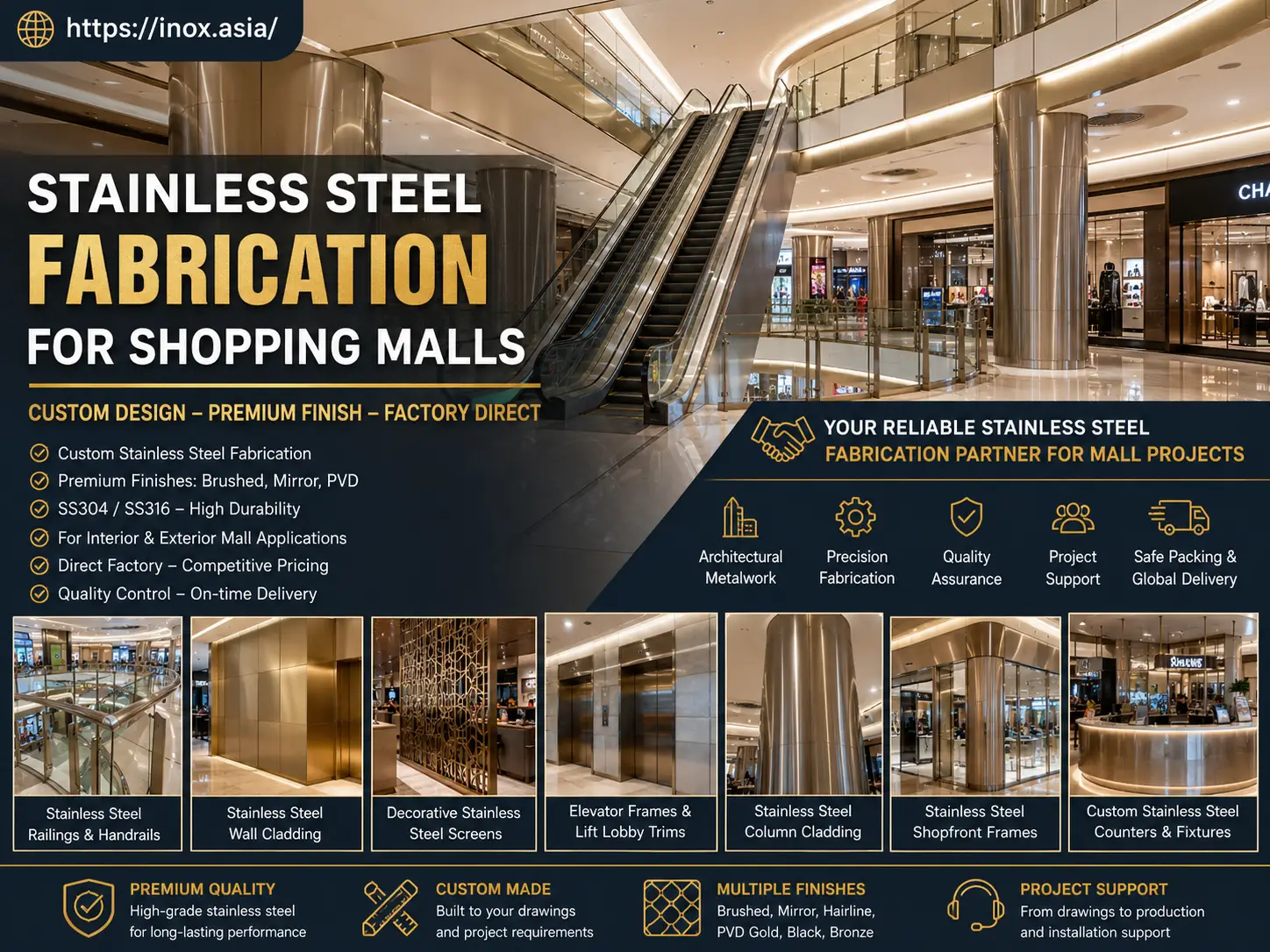
In shopping mall construction, stainless steel is used in many places. Some products are structural or functional, such as stainless steel handrails, stair railings, balcony railings, escalator side details and protection trims. Some products are decorative, such as stainless steel wall cladding, column cladding, ceiling trims, decorative screens, shopfront frames and signage frames. Other items are customized for tenant areas, kiosks, counters, food courts, restaurants and VIP commercial spaces.
Unlike standard retail products, architectural stainless steel fabrication usually follows project drawings. The factory needs to understand dimensions, material grade, surface finish, welding details, edge treatment, fixing method, packaging requirement and installation sequence. A shopping mall may use hundreds or thousands of stainless steel parts, so consistency is very important.
A complete commercial stainless steel fabrication scope may include:
- Reviewing architectural drawings and shop drawings.
- Confirming SS304 stainless steel, SS316 stainless steel or other project-required material grades.
- Preparing finish samples such as brushed stainless steel, mirror stainless steel, hairline finish, PVD gold, champagne gold, bronze or black titanium stainless steel.
- Using CNC laser cutting, sheet metal bending, welding and polishing.
- Checking size, welding quality, surface consistency and edge finishing.
- Protecting surfaces with film, foam, wooden packing or project-specific packaging.
- Supporting contractors with installation-friendly fabrication details.
For mall projects, stainless steel fabrication should be planned as part of the commercial fit-out process, not only as a material purchase. The final result depends on the connection between design, factory production and on-site installation.
Why Shopping Malls Need Custom Stainless Steel Fabrication
Shopping malls are high-traffic public buildings. They require materials that can handle daily use, cleaning, humidity, customer movement, tenant changes and long operating hours. Stainless steel is widely used because it offers good durability, design flexibility and a premium commercial appearance.

However, ready-made stainless steel products often cannot meet the requirements of a large mall project. Every mall has different atrium shapes, corridor widths, lift lobby layouts, shopfront designs, ceiling heights and interior concepts. Custom stainless steel fabrication allows the project team to control product size, structure, finish, installation method and visual consistency.
There are several reasons shopping malls need custom stainless steel products:
- Project-specific dimensions: Railings, cladding panels, trims and frames must fit the actual site conditions.
- Design consistency: Stainless steel details should match stone, glass, lighting, ceiling, wood, signage and brand identity.
- Better finish control: Brushed, mirror, champagne, bronze, gold and black titanium finishes need sample approval and consistent production.
- Installation coordination: Stainless steel parts often connect with glass, stone, aluminum, ceiling, lighting, flooring and MEP systems.
- Long-term maintenance: Public areas need details that are not only beautiful but also practical to clean and maintain.
- Factory pricing: Working directly with a stainless steel fabrication manufacturer can help project buyers control cost and lead time.
In many commercial projects, the problem is not only the material price. The bigger issue is whether the fabricated product fits the site, matches the approved sample and arrives with proper surface protection. A lower unit price may become expensive if panels are scratched, colors are inconsistent or dimensions are wrong.
For this reason, project teams usually need a custom stainless steel fabrication factory that can read drawings, discuss details and produce according to confirmed requirements.
Common Stainless Steel Applications in Shopping Malls
Stainless steel for shopping malls can be used in both visible decorative areas and functional public areas. The best application depends on traffic level, design style, budget, maintenance plan and environmental conditions.
| Stainless Steel Item | Common Mall Application | Recommended Material | Finish Options | Key Notes for Projects |
|---|---|---|---|---|
| Stainless steel railings and handrails | Escalators, stairs, balconies, atriums, corridors | SS304 or SS316 depending on location | Brushed, mirror, hairline, PVD | Confirm load requirement, fixing method, glass connection and site dimensions. |
| Stainless steel wall cladding | Lift areas, corridors, lobbies, public zones | SS304 commonly used for interior areas | Brushed, mirror, champagne, bronze, black titanium | Panel flatness, joint lines and surface protection are very important. |
| Decorative stainless steel screens | Restaurants, VIP areas, brand stores, commercial partitions | SS304 for most indoor decorative use | PVD gold, bronze, black titanium, brushed | Pattern design, cutting accuracy, frame strength and installation method should be reviewed. |
| Stainless steel shopfront frames | Retail entrances, brand stores, display windows | SS304 or project-specified grade | Mirror, brushed, PVD champagne, black titanium | Must coordinate with glass, doors, signage and lighting. |
| Stainless steel elevator frames | Lift doors, lift lobby trims, entrance frames | SS304 for most interior lift lobby areas | Hairline, brushed, mirror, PVD bronze, champagne | High visibility area; finish consistency and scratch protection are critical. |
| Stainless steel column cladding | Atriums, corridors, entrance halls, retail floors | SS304 or project-required material | Mirror, brushed, PVD, black titanium, bronze | Curved shape, panel joints and site measurement must be checked carefully. |
| Stainless steel skirting and trims | Wall bases, ceilings, corners, flooring transitions | SS304 for commercial interiors | Brushed, hairline, mirror, PVD | U trims, T trims, L trims and flat trims need accurate bending and packing. |
| Stainless steel counters and kiosks | Food courts, service counters, pop-up retail areas | SS304 or SS316 depending on moisture and cleaning exposure | Brushed, hairline, mirror, PVD | Coordinate with lighting, glass, stone, wood and electrical details. |
These items may look simple when listed in a BOQ, but each group has different fabrication requirements. Railings need strength and safe fixing. Wall cladding needs flatness and clean joints. Decorative screens need precise cutting and clean finishing. Elevator frames need high visual consistency because customers see them every day.
Stainless Steel Railings and Handrails for Mall Projects
Mall stainless steel railing systems are commonly used around escalators, staircases, balconies, atriums, bridges, corridors and open public areas. They are among the most important stainless steel items in shopping mall construction because they combine safety, appearance and heavy daily use.
For railing and handrail projects, stainless steel can be used alone or combined with glass, stone, aluminum or wood. Many malls prefer stainless steel glass railing because it keeps the interior open and bright. Brushed stainless steel is practical for high-traffic areas because minor fingerprints and small marks are less visible than mirror finish. Mirror stainless steel looks more luxurious, but it requires better protection during transport and installation.
Common applications include:
- Escalator side railings and protection details.
- Staircase handrails for public access areas.
- Atrium balcony railings with glass panels.
- Stainless steel handrail systems for corridors and ramps.
- Guardrails for public zones and commercial walkways.
From factory experience, one detail we always check before production is the fixing method. A railing may look correct in the design drawing, but the final fabrication depends on site structure, base plate design, glass thickness, installation sequence and safety requirement. The factory should not cut and weld large quantities before these details are confirmed.
For indoor mall areas, SS304 stainless steel is often used, but the final material should follow project drawings and local requirements. For areas near water features, toilets, food and beverage zones, outdoor entrances or humid conditions, material selection should be reviewed more carefully. In some cases, SS316 stainless steel may be considered, depending on the environment and project specification.
Advantages of stainless steel railings for shopping malls include:
- Clean commercial appearance.
- Good durability for high-traffic public areas.
- Compatibility with glass and modern interior design.
- Multiple finish choices for different mall concepts.
- Custom dimensions according to drawings and site measurements.
Points to pay attention to include welding quality, polishing consistency, edge treatment, fixing strength, packing protection and installation coordination. For high-traffic shopping malls, surface protection during transport and installation is just as important as polishing quality.
Stainless Steel Wall Cladding for Shopping Mall Interiors
Stainless steel wall cladding is widely used in shopping mall interiors, especially in lift lobbies, corridors, entrance halls, public zones, retail areas and high-end commercial spaces. It gives walls a clean, durable and premium finish while helping protect surfaces from daily contact.
Common locations for stainless steel wall cladding include:
- Lift lobby walls and elevator entrance areas.
- Corridor wall protection panels.
- Shopping mall entrance feature walls.
- Brand store interior walls.
- Food court and restaurant feature areas.
- VIP lounge and commercial reception zones.
Wall cladding can use brushed stainless steel, mirror stainless steel, hairline finish, champagne gold stainless steel, bronze stainless steel finish, black titanium stainless steel or other PVD stainless steel colors. The finish should match the interior concept and maintenance expectation.
Mirror stainless steel creates a bright luxury effect, but scratches and fingerprints are more visible. Brushed stainless steel and hairline stainless steel are more practical in many public areas. PVD stainless steel can create a premium color effect, but the approved sample should be used as the reference before mass production.
For wall cladding projects, the factory should check:
- Panel dimensions and layout direction.
- Joint line design and installation gap.
- Wall flatness and substrate condition.
- Corner details and edge folding.
- Opening positions for signage, lighting or access panels.
- Protective film direction and packing method.
A common mistake in stainless steel wall cladding projects is treating all panels as simple flat sheets. In real mall interiors, many panels need bending, welding, corner finishing, back reinforcement or installation clips. If the drawing is not clear, the factory should confirm dimensions before cutting material.
For large shopping mall projects, mock-up approval is useful. A mock-up sample helps the project owner, architect and contractor confirm finish, joint detail, color tone, reflection and installation method before mass production.
Decorative Stainless Steel Screens for Commercial Spaces
Stainless steel decorative screens are often used in shopping malls to divide spaces without making the interior feel closed. They are popular in restaurants, brand stores, VIP areas, lounges, commercial partitions, display zones and feature walls.
A stainless steel decorative screen can be made by CNC laser cutting, bending, welding, polishing and PVD coating. The design may be simple geometric lines, brand-inspired patterns, luxury decorative motifs or custom architectural patterns. For commercial interiors, the screen must look attractive from the front, but the back side, edges and frame details should also be considered.
Common applications include:
- Restaurant partitions inside shopping malls.
- Decorative dividers for luxury retail stores.
- VIP lounge screens.
- Commercial corridor feature panels.
- Reception and waiting area partitions.
- Brand display backgrounds.
Popular finish options include PVD gold, champagne gold stainless steel, bronze stainless steel finish, brushed stainless steel and black titanium stainless steel. PVD color should be confirmed by sample before mass production because color tone can look different under mall lighting.
Advantages of decorative stainless steel screens include:
- Strong visual impact for commercial interiors.
- Flexible pattern customization.
- Good compatibility with glass, stone, wood and lighting.
- Suitable for brand stores, restaurants and luxury public areas.
- Can be produced according to architectural drawings or 3D renderings.
Points to consider include pattern strength, frame design, installation method, edge finishing and surface protection. Very thin or complex patterns may look beautiful in a rendering, but the factory should check whether the design is practical for cutting, polishing, transport and installation.
From factory experience, decorative screens should not be evaluated only by the front view. The project team should also review thickness, frame structure, back fixing, welding marks, polishing direction and how the screen connects with floor, ceiling or wall details.
Stainless Steel Elevator Frames, Column Cladding and Trims
Elevator areas are some of the most visible parts of a shopping mall. Customers use lifts repeatedly, and the lift lobby often affects the first impression of each floor. Stainless steel elevator frames, lift door trims, wall trims and ceiling details help create a clean and durable finish around these areas.
Common stainless steel elevator and lift lobby items include:
- Stainless steel elevator door frames.
- Lift lobby wall trims.
- Stainless steel ceiling trims around lift areas.
- Decorative panels beside elevator doors.
- Stainless steel skirting in lift lobbies.
- Signage frames and direction board details.
Hairline stainless steel and brushed stainless steel are often practical for elevator frames because they provide a clean look and reduce the visibility of small marks. Mirror and PVD finishes can be used for luxury areas, but protection must be planned carefully.
Stainless steel column cladding is another important item in shopping malls. Columns are found in atriums, corridors, entrances, retail floors and food courts. Stainless steel column cladding can turn structural columns into decorative architectural features. It can be round, square, curved or custom-shaped depending on the building design.
For column cladding, site measurement is very important. Even small differences in column size, wall flatness or floor level can affect panel installation. The factory should check the panel layout, joint position, bending radius, fixing method and packing sequence before production.
Stainless steel trims are used throughout mall interiors. These include stainless steel skirting, ceiling trims, U trims, T trims, L trims and flat trims. They may look small, but they are important for finishing details between walls, floors, ceilings, glass, stone and panels.
Typical trim applications include:
- Floor and wall junctions.
- Ceiling edge details.
- Wall panel joints.
- Glass partition edges.
- Stone and tile transition details.
- Shopfront finishing lines.
For trims, accuracy matters. A trim profile with poor bending accuracy or inconsistent surface finish can make the whole commercial fit-out look unfinished. For large projects, the factory should label profiles clearly, protect visible surfaces and pack long items properly to avoid bending during transport.
Brushed, Mirror and PVD Stainless Steel Finishes for Shopping Malls
Surface finish is one of the most important decisions in architectural stainless steel fabrication. The same stainless steel item can look very different depending on whether it uses brushed, mirror, hairline, PVD gold, champagne, bronze or black titanium finish.
For shopping malls, finish selection should consider design style, lighting, traffic level, maintenance and installation risk. A luxury retail area may prefer mirror stainless steel or champagne gold stainless steel. A public corridor may need brushed stainless steel because it is easier to maintain. A restaurant zone may use bronze stainless steel finish or black titanium stainless steel to create a warmer interior style.
Common finish options include:
- Brushed stainless steel: Practical, modern and suitable for many public areas.
- Hairline stainless steel: Clean linear texture, commonly used for elevator frames, trims and wall panels.
- Mirror stainless steel: Bright and premium, suitable for luxury areas but needs careful protection.
- PVD gold stainless steel: Decorative and high-end, often used in hotels, malls, restaurants and VIP zones.
- Champagne gold stainless steel: Softer luxury tone for modern commercial interiors.
- Bronze stainless steel finish: Warm and elegant, suitable for restaurants, lounges and brand stores.
- Black titanium stainless steel: Strong modern look, often used for luxury shopfronts, partitions and trims.
One practical point is lighting. Stainless steel color and reflection can look different under natural light, warm light or cool white mall lighting. That is why finish sample approval is necessary before mass production. The approved sample should be kept as the production reference.
Mirror finish looks premium, but it needs better protection during installation. PVD stainless steel looks elegant, but color difference must be controlled. Brushed finish is easier to use in high-traffic areas, but polishing direction should remain consistent across panels and profiles.
For large shopping mall projects, the factory should confirm:
- Finish type and sample reference.
- Polishing direction.
- Color tone for PVD stainless steel.
- Protective film quality.
- Panel batch consistency.
- Packaging method for finished surfaces.
SS304 vs SS316 Stainless Steel for Commercial Projects
SS304 stainless steel and SS316 stainless steel are both used in commercial stainless steel fabrication. The right choice depends on project location, environment, drawing requirement, budget and maintenance expectation.
For many indoor shopping mall areas, SS304 stainless steel is commonly used because it offers a good balance between appearance, durability and cost. It is suitable for many interior applications such as wall cladding, trims, decorative screens, shopfront frames, elevator frames and indoor handrails.
SS316 stainless steel may be considered for more demanding environments, especially where the stainless steel is exposed to higher humidity, outdoor conditions, water features, coastal air, pool areas, toilet zones or certain food and beverage conditions. The final selection should follow the project specification and be confirmed according to the actual environment.
From factory experience, the grade decision should not be made only by price. The project team should consider where the item will be installed and how it will be cleaned. Indoor decorative panels in a dry corridor have different requirements from handrails near an outdoor entrance or stainless steel details close to wet areas.
Before confirming material, the customer should share:
- Project location.
- Indoor or outdoor use.
- Humidity and cleaning conditions.
- Whether the item is near toilets, F&B areas, water features or outdoor entrances.
- Architectural specification.
- Expected finish and maintenance requirement.
A responsible stainless steel fabrication manufacturer should not simply recommend the most expensive material. The better approach is to review the project condition and suggest a suitable material based on drawings, use location and project requirement.
Custom Stainless Steel Fabrication Process for Shopping Mall Projects
A clear fabrication process helps reduce mistakes, delays and rework. For shopping mall projects, the process usually starts before production. Drawing review, sample approval and technical confirmation are often more important than the cutting itself.
A typical custom stainless steel fabrication process includes:
- 1. Drawing review: The factory checks architectural drawings, shop drawings, dimensions, sections and installation details.
- 2. Material confirmation: The project team confirms SS304, SS316 or other required stainless steel grade.
- 3. Finish sample approval: Brushed, mirror, PVD, champagne, bronze or black titanium samples are confirmed before production.
- 4. Shop drawing coordination: If needed, fabrication details are adjusted for production and installation.
- 5. Mock-up sample: For important visible areas, a sample or mock-up can be produced for approval.
- 6. CNC laser cutting: Stainless steel sheets are cut according to confirmed dimensions and patterns.
- 7. Sheet metal bending: Panels, trims, frames and profiles are bent according to drawings.
- 8. Welding and polishing: Welded parts are finished carefully to meet visual requirements.
- 9. Surface finishing: Final brushing, polishing or PVD coating is completed according to approved samples.
- 10. Quality inspection: Dimensions, surface, welding, color and packing are checked before shipment.
- 11. Packing and labeling: Items are protected, labeled and packed for project delivery.
For shopping mall projects, coordination between the factory and contractor is very important. Stainless steel products often arrive after civil works, stone works, glass works or ceiling works have started. If installation details are not confirmed early, the site team may need to modify parts on site, which can damage the finish.
A direct custom stainless steel fabrication factory can support this process by reviewing drawings and production feasibility before mass production.
Quality Control Points Before Mass Production
Quality control should begin before the first batch is produced. Once stainless steel panels, railings or frames are mass-produced, correcting mistakes can be expensive and time-consuming. For mall projects, the factory should confirm key details before production starts.
Important quality control points include:
- Material grade: Confirm stainless steel grade according to drawings and project specification.
- Thickness: Confirm according to drawings, structure, location and project requirements.
- Finish sample: Keep approved finish samples as reference for production.
- Dimensions: Check drawings, site measurements and tolerance requirements.
- Welding quality: Review welding position, grinding marks and visible surfaces.
- Polishing consistency: Make sure surface direction and texture are consistent.
- PVD color consistency: Control color tone based on approved sample.
- Edge treatment: Avoid sharp, rough or unfinished edges in public areas.
- Assembly fit: Check connection between panels, frames, trims and fixing parts.
- Packing protection: Protect visible surfaces during transport and site handling.
For public areas with heavy traffic, design details should not only look beautiful but also be easy to maintain. Sharp corners, difficult cleaning gaps, weak fixing points or overly delicate patterns may create problems after the mall opens.
From factory experience, surface scratches are one of the most common issues in stainless steel projects. Sometimes the product leaves the factory in good condition, but damage happens during transport, unloading or installation. Proper protective film, foam, carton, wooden crate and clear labeling can reduce this risk.
How to Choose a Stainless Steel Fabrication Manufacturer
Choosing the right stainless steel fabrication manufacturer is important for shopping mall projects. The supplier should not only offer a price. They should be able to understand drawings, discuss details, control finishing and support project delivery.
When evaluating a manufacturer, consider the following points:
- Project experience: Has the factory worked with commercial stainless steel fabrication or architectural metalwork?
- Drawing capability: Can the team read architectural drawings and shop drawings?
- Material knowledge: Can they advise on SS304, SS316 and different application environments?
- Finish control: Can they provide brushed, mirror, hairline and PVD stainless steel samples?
- Production equipment: Do they support CNC laser cutting, bending, welding and polishing?
- Quality inspection: Do they check dimensions, surface quality, welding and packing?
- Communication: Can they clarify details before production instead of guessing?
- Packing: Can they protect finished surfaces for long-distance delivery?
A good stainless steel fabrication manufacturer should ask questions before quoting. If a supplier gives a final price without checking drawings, material grade, finish, quantity, installation condition and packing requirement, the quotation may not be reliable.
For B2B project buyers, the best supplier is usually not the one with the shortest reply only. It is the one that can reduce project risk by confirming details clearly before production.
Common Mistakes to Avoid in Mall Stainless Steel Projects
Stainless steel items in shopping malls are highly visible. Small mistakes can affect the final appearance of the whole area. Many problems can be avoided if the project team confirms technical details early.
Common mistakes include:
- Choosing finish only from photos: Stainless steel color and reflection can look different in real lighting. Samples should be approved.
- Ignoring site measurement: Actual site dimensions may differ from drawings, especially for cladding and trims.
- Using mirror finish in high-risk areas without protection: Mirror finish needs careful handling during installation.
- Not confirming polishing direction: Different polishing directions can make panels look inconsistent.
- Ordering without clear shop drawings: Vague drawings can cause cutting and bending mistakes.
- Overlooking packing: Poor packing can damage finished surfaces before the products reach the site.
- Not coordinating with other trades: Stainless steel often connects with glass, stone, ceiling, lighting and flooring.
- Selecting material only by lowest price: The use location and maintenance condition should guide material selection.
One detail we always check before production is whether the visible surface is clearly marked. For stainless steel panels, frames and trims, knowing which side is visible helps the factory protect the correct surface and control polishing direction.
Another important point is installation sequence. If stainless steel products are installed before heavy construction work is finished, the risk of scratches is higher. Contractors should plan protection during and after installation.
What Information Should You Send for a Quotation?
To receive an accurate quotation for Stainless Steel Fabrication for Shopping Malls, the factory needs more than a product name. A clear quotation depends on drawings, quantity, material, finish, packing and delivery requirements.
Before requesting a price, prepare the following information if available:
- Architectural drawings: Plans, elevations, sections and details help the factory understand the design.
- Shop drawings: Fabrication drawings provide more accurate dimensions and installation details.
- 3D renderings: Renderings help confirm visual intent, especially for decorative screens, cladding and shopfronts.
- Quantity list: BOQ or item list helps calculate material, production time and packing.
- Material grade requirement: SS304, SS316 or other project-specified stainless steel grade.
- Finish sample requirement: Brushed, mirror, hairline, PVD gold, champagne, bronze, black titanium or other finish.
- Project location: Indoor, outdoor, coastal, humid or special environment should be noted.
- Installation condition: Wall type, base structure, glass connection, ceiling condition or site limitations.
- Delivery schedule: Required production time, shipment time and project deadline.
- Packing requirement: Standard packing, wooden crate, export packing or special surface protection.
If you do not have complete shop drawings yet, you can still send architectural drawings, sketches, site photos and approximate quantities. The factory can review the information and suggest what needs to be confirmed before final pricing.
Share your mall project drawings and quantity list for factory pricing. Our team can help review material, finish and fabrication details before quotation.
Why Work with a Direct Stainless Steel Fabrication Factory?
Working with a direct stainless steel fabrication factory can be helpful for shopping mall projects because communication is closer to production. The factory can review drawings, check feasibility, confirm finish samples and control fabrication details directly.
For contractors, architects and project buyers, this can bring several advantages:
- Better technical communication: Fabrication questions can be answered by the production team.
- More flexible customization: Sizes, profiles, frames, panels and finishes can be made according to drawings.
- Factory pricing: Direct production can help control project cost.
- Sample confirmation: Material and finish samples can be reviewed before mass production.
- Quality control: Dimensions, welding, polishing and packing can be checked before delivery.
- Project coordination: The factory can support phased production and item labeling for installation.
However, a direct factory still needs clear project information. Good fabrication depends on good drawings, confirmed samples and clear communication. If the design changes after production begins, cost and lead time may change. That is why early coordination is important.
At Inox Asia, we focus on stainless steel products for commercial projects, including shopping malls, hotels, villas, showrooms, restaurants and public commercial spaces. Project teams can send drawings, finish requirements and quantity lists for review.
FAQ About Stainless Steel Fabrication for Shopping Malls
What is stainless steel fabrication for shopping malls?
Stainless steel fabrication for shopping malls is the custom production of stainless steel items such as railings, handrails, wall cladding, decorative screens, shopfront frames, elevator frames, column cladding, trims, signage frames, counters and commercial fixtures according to project drawings and specifications.
Which stainless steel grade is suitable for shopping malls?
SS304 stainless steel is commonly used for many indoor mall applications. SS316 stainless steel may be considered for more humid, outdoor, coastal, wet or demanding environments. The final grade should be confirmed based on drawings, location, exposure, maintenance and project requirements.
Is SS304 enough for mall interior projects?
For many dry indoor mall areas, SS304 stainless steel can be suitable. However, areas near toilets, water features, F&B zones, outdoor entrances or high-humidity conditions should be reviewed carefully before confirming the material.
What finishes are popular for mall stainless steel products?
Popular finishes include brushed stainless steel, hairline stainless steel, mirror stainless steel, PVD gold stainless steel, champagne gold stainless steel, bronze stainless steel finish and black titanium stainless steel. Finish samples should be approved before mass production.
Can stainless steel products be customized according to drawings?
Yes. Custom stainless steel fabrication can follow architectural drawings, shop drawings, 3D renderings, site measurements and project specifications. Common customized items include railings, wall panels, trims, screens, frames, counters, kiosks and decorative metalwork.
What should I prepare before requesting a quotation?
You should prepare architectural drawings, shop drawings, 3D renderings if available, quantity list, material grade requirement, finish sample requirement, project location, installation condition, delivery schedule and packing requirement.
How do you protect stainless steel surfaces during shipping?
Finished stainless steel surfaces are usually protected with film, foam, carton, wooden crate or project-specific export packing. The packing method depends on product size, finish type, transport distance and site handling conditions.
Why should I choose a direct factory instead of a trading company?
A direct factory can communicate more closely with production, review drawings, confirm samples, control fabrication details and support customized requirements. This can help project teams manage quality, cost and delivery more effectively.
Conclusion: Send Your Mall Drawings for Factory Review
Stainless Steel Fabrication for Shopping Malls requires more than cutting and polishing stainless steel. It requires drawing review, material selection, finish sample approval, welding control, polishing consistency, packaging protection and installation coordination.
For shopping mall projects, stainless steel details are visible to thousands of visitors every day. Railings, wall cladding, decorative screens, elevator frames, shopfront details, column cladding, skirting and trims all affect the final commercial appearance. They also need to handle real public use after the mall opens.
If you are an architect, contractor, fit-out company, developer or project buyer, the best way to start is to send your drawings, quantity list, finish requirement and project location. A direct factory can review the details and provide a more realistic quotation based on actual fabrication requirements.
Contact our team to review material, finish and fabrication details for your shopping mall project.
CONTACT INFORMATION
Inox Asia – Custom Stainless Steel Fabrication
📍 Showroom: No. 06-106, Vinhomes Ocean Park 3 Urban Area, Nghia Tru Commune, Van Giang District, Hung Yen Province, Vietnam
📍 Factory address: No. 10, No. 6 1st Road, Pingsheng Industrial East Zone, Guicheng Street, Nanhai District, Foshan City, Guangdong Province, China
📞 WhatsApp / Zalo: 0386 122 996
📧 Email: [email protected]
Facebook: facebook.com/inoxhengde
TikTok: tiktok.com/@inox.asia
YouTube: youtube.com/@inoxasiacssf