
A low quotation can become expensive very quickly when fabricated stainless steel reaches the project with the wrong dimensions, an inconsistent finish, poorly blended welds or packaging that does not protect the visible surfaces.
For architects, contractors, developers and procurement teams searching for a Stainless Steel Fabrication Supplier for Indonesia, the decision therefore involves more than comparing a price per kilogram or selecting a supplier from product photographs.
The supplier may need to interpret architectural drawings, shop drawings, BOQs, tender specifications, finish samples, site dimensions or an existing product sample and translate that information into something that can actually be fabricated, inspected, packed and installed.
This becomes particularly important for project-based stainless steel work used in hotels, resorts, villas, commercial developments, retail interiors, residential buildings and other architectural applications in Indonesia. A component can be technically made from stainless steel and still be unsuitable for the project if the grade, finish direction, weld location, fixing detail or installation interface was misunderstood.
Inox Asia operates as a direct custom stainless steel fabrication supplier supporting production according to drawings, samples, site dimensions and project specifications. For buyers evaluating an overseas supplier, the practical question is not simply, “Can this factory make stainless steel products?” The more useful question is: can the supplier understand and control the details that determine whether those products will work when they arrive at the project?
What Should an Indonesian Buyer Expect From a Stainless Steel Fabrication Supplier?
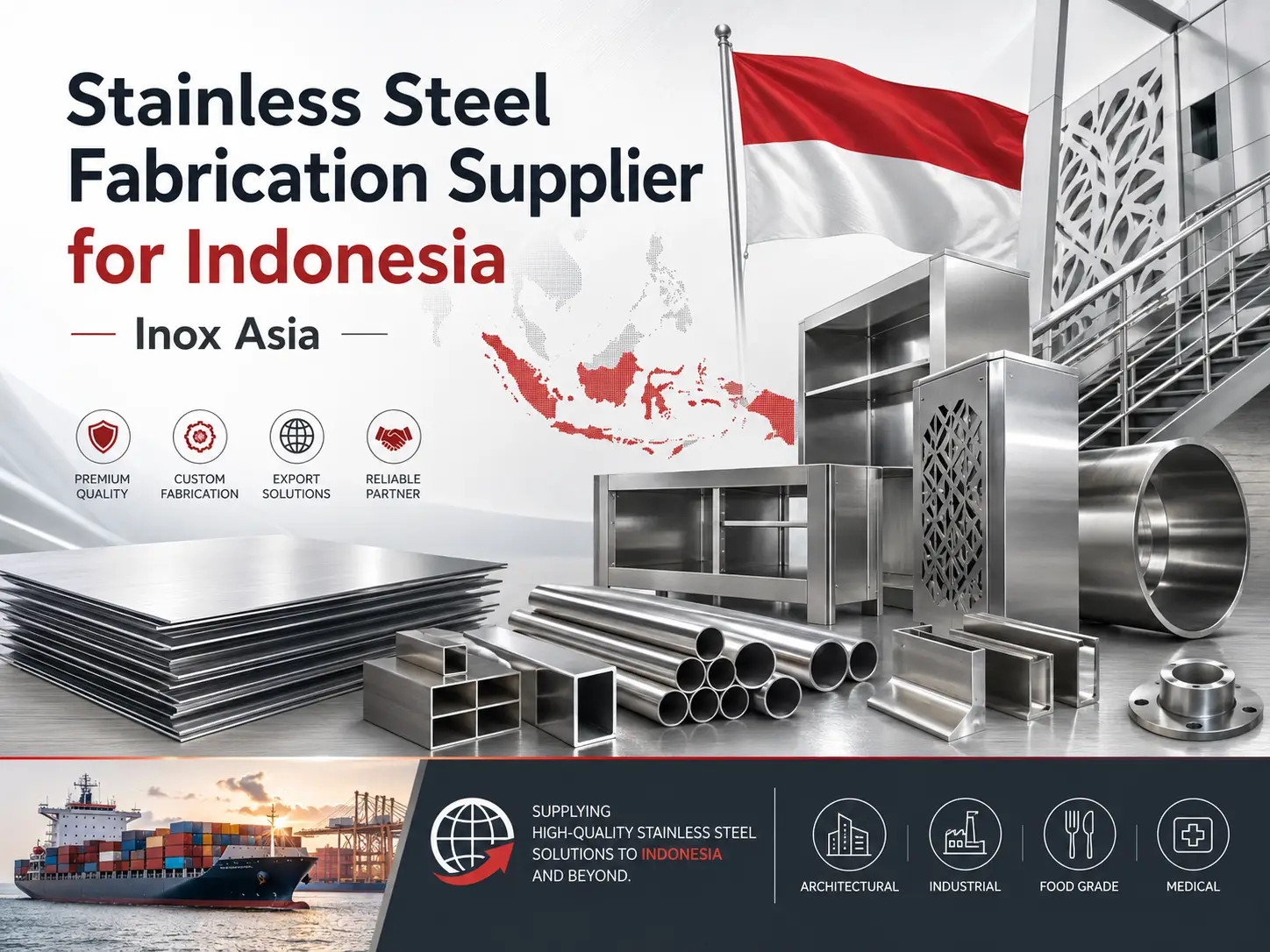
A capable fabrication supplier should be able to move beyond a general promise of “good quality.” In project procurement, quality has to be translated into measurable and reviewable details.
At the RFQ stage, buyers should look at how the supplier handles the following areas:
- Technical and shop drawings
- Material grade and thickness
- Fabrication feasibility
- Joint and welding requirements
- Visible and non-visible surfaces
- Surface finish and finish direction
- Dimensions and project-specific tolerances
- Assembly requirements
- Interface with glass, stone, timber, aluminum or other materials
- Quality inspection
- Protective film and finished-surface handling
- Component identification and packing
- Export packing requirements
- Project communication and technical clarification
The first indication often appears before an order is placed. If the supplier receives an incomplete drawing and immediately gives a final production quotation without asking about missing material, finish, visible surfaces or installation conditions, the quotation may not cover the same scope the buyer has in mind.
That detail matters because fabrication errors are rarely limited to the cost of the metal itself. A wrong hole position may require site modification. A scratched mirror panel may require replacement. A finish mismatch across several batches may delay handover. A missing component can create an urgent replacement shipment.
For procurement teams, the correct comparison is therefore not simply purchase price. It is purchase price plus the potential cost of failure.
Stainless Steel Fabrication Supplier for Indonesia: Direct Factory vs Trading Company
There is no supplier model that is automatically best for every project. A local fabricator, trading company and overseas direct factory each solve different procurement problems.
| Supplier Type | Best Suited For | Technical Communication | Customization | Site Flexibility | Key Consideration |
|---|---|---|---|---|---|
| Local Indonesian Fabricator | One-off work, site-dependent fabrication and projects requiring frequent modifications | Usually convenient for site coordination | Depends on workshop capability | High | Useful when final dimensions change during construction |
| Direct Overseas Factory | Finalized drawings, repeatable components, customized products and batch project orders | Technical questions can communicate more directly with production | Potentially high when the factory specializes in custom fabrication | Lower after shipment | Drawings and approvals should be controlled before production |
| Trading Company | Buyers needing sourcing support across multiple products or factories | Communication normally passes through another layer | Depends on the manufacturing partner | Varies | The buyer should understand who actually controls fabrication |
| General Metal Supplier | Standard materials and relatively simple requirements | May be less fabrication-focused | Usually more limited for complex architectural work | Varies | Confirm whether fabrication is performed internally or subcontracted |
A local stainless steel fabricator in Indonesia may be the practical choice for a staircase that still needs repeated site measurement or a renovation where dimensions are changing during construction.
An overseas direct factory can become more attractive when the drawings are finalized, there are repeated components, the project requires a controlled decorative finish, or procurement wants custom production directly from a manufacturing source.
A trading company may also add value when the buyer needs multiple unrelated product categories consolidated through one commercial contact.
The decision should follow the project structure rather than a general belief that one sourcing model is always cheaper or better.
Stainless Steel Grades Commonly Considered for Indonesian Projects

304 and 316 are two stainless steel grades commonly considered for architectural and fabrication projects, but the correct choice depends on the actual exposure environment, project specification and required corrosion resistance.
Indonesia includes tropical, humid and coastal environments, but that does not mean every project automatically requires 316 stainless steel. An interior decorative trim in an air-conditioned commercial space has a very different exposure condition from exterior metalwork near a marine environment.
AISI 304 Stainless Steel
304 is commonly considered for many general architectural and interior stainless steel applications. It may be appropriate for decorative panels, trims, cabinets, partitions, railings and other fabricated products where the specified environment and corrosion exposure are compatible with the material.
However, “indoor” alone is not enough information. Wet areas, aggressive cleaning products, high humidity or unusual environmental exposure may change the material requirement.
AISI 316 Stainless Steel
316 is generally considered where higher corrosion resistance is required, particularly when chloride or coastal exposure is an important project factor.
For Indonesian projects near coastal zones, resorts, exposed exterior areas or other corrosive environments, 316 may therefore deserve consideration. It should still not be specified automatically without reviewing the real application and design documentation.
304L and 316L
Low-carbon variants such as 304L and 316L may appear in project specifications, particularly where welding and material requirements are defined by engineering documentation. If a project calls for a specific grade designation, the quotation and material procurement should follow that requirement rather than replacing it with a general “stainless steel” description.
| Factor | 304 | 316 | Buyer Consideration |
|---|---|---|---|
| General Interior Use | Commonly considered | May be unnecessary for some applications | Check actual environment and project specification |
| High Humidity | Application-dependent | May provide additional corrosion resistance | Humidity alone does not define the final grade |
| Coastal Exposure | Requires careful review | Often considered where stronger corrosion resistance is required | Confirm distance, exposure, maintenance and project specification |
| Decorative Interior Fabrication | Frequently considered | Possible if specified or environmentally justified | Finish and appearance are separate from grade selection |
| Cost | Generally lower material cost than 316 | Generally higher material cost | Do not specify a higher grade without understanding the requirement |
Material grade should also be separated from surface appearance. A gold, bronze, black or hairline decorative finish does not by itself tell the buyer whether the base material is 201, 304 or 316.
The grade should be stated clearly in the RFQ and quotation.
Custom Stainless Steel Fabrication Services for Indonesia
A custom stainless steel fabrication order normally involves several manufacturing operations rather than a single process.
Inox Asia publicly describes capabilities that include CNC laser cutting, bending and forming, welding, assembly and surface finishing for project-based stainless steel work.
Its broader custom stainless steel fabrication factory information also describes fabrication based on drawings, samples, site dimensions and project design requirements.
Cutting
Cutting determines the geometry that later operations depend on. Incorrect openings, slots, edge dimensions or hole positions can continue through bending and assembly before anyone notices the problem.
For that reason, the production drawing should clearly separate critical dimensions from reference dimensions where appropriate.
Bending and Forming
A flat drawing can look simple while the formed component is not. Bend position, inside geometry, return edges, panel interfaces and final installation clearances all affect whether a component can be produced as intended.
The required dimensional tolerance should be defined on the drawing and reviewed according to the product and fabrication process. A universal tolerance should not be assumed for every fabricated stainless steel item.
Welding and Assembly
Architectural welding needs to be considered from two perspectives.
The first is whether the joint performs its structural or assembly function. The second is whether a visible welded area can be finished to the visual standard required by the project.
These are not the same problem.
For polished or decorative stainless steel, weld blending can become more visually demanding than the welding operation itself. A joint that appears acceptable before finishing may become noticeable after a mirror, brushed or hairline surface is viewed under strong project lighting.
Grinding, Polishing and Surface Finishing
The visual surface often determines whether architectural stainless steel is accepted or rejected.
A stainless steel component may be dimensionally correct and still fail a visual inspection because the grinding marks are visible, the hairline runs in the wrong direction or adjacent pieces show different levels of reflection.
For architectural trim applications, Inox Asia’s stainless steel trim panel and profiled plate guide illustrates how finish, profile geometry, lighting, joints and surrounding materials affect the final appearance.
Have a stainless steel project for Indonesia? Send the drawings, specifications, quantities and required finish for fabrication review before finalizing the order.
Stainless Steel Products That Can Be Fabricated for Indonesian Projects
Custom fabrication should be evaluated according to the product and application rather than treated as one broad category.
Architectural Stainless Steel
Architectural metalwork can include trims, profiles, decorative panels, wall cladding, column details, frames, railings and other fabricated components that interact directly with surrounding building materials.
These items often require coordination with stone, glass, timber, aluminum, ceiling systems or structural substrates.
Stainless Steel Panels and Cladding
Large decorative surfaces create a different set of fabrication risks from small trim profiles. Flatness, panel joints, edge returns, reflection, installation method and protection during shipment become more visible as panel size increases.
Inox Asia also publishes details about its stainless steel honeycomb panel fabrication for walls, partitions, feature areas and other architectural interior applications.
Railings and Handrails
Railings involve appearance, fabrication and installation interfaces at the same time. Drawings need to identify fixing conditions, transitions, posts, handrail geometry, connection details and interfaces with glass or adjacent building work.
For buyers evaluating this product category, the published stainless steel railing fabrication guide provides examples of project considerations for railings used in hospitality, villas and commercial environments.
Bathroom and Hospitality Metalwork
Hotel and villa bathrooms introduce additional concerns such as moisture, glass coordination, frame dimensions, hardware interfaces and finish consistency across repeated rooms.
The company’s stainless steel shower cubicle project guide is relevant where stainless steel frames and glass need to be coordinated as a complete fabricated assembly.
Cabinets and Feature Furniture
Cabinet fabrication can combine stainless steel frames with glass, shelves, hardware, lighting and other decorative materials. The visible geometry may need to align with an interior design concept rather than a simple engineering component.
For this application, buyers can review the published decorative stainless steel cabinet information when preparing project specifications.
Partitions and Screens
Partitions can introduce a combination of metal fabrication, glass coordination, repeated spacing, pattern alignment and installation framing.
Inox Asia also provides a reference for stainless steel and wired glass partition systems used in architectural interiors.
Why Surface Finish Matters More Than Many Buyers Expect
For architectural stainless steel, surface finish should be treated as part of the specification, not as a final cosmetic decision made after fabrication.
Brushed, satin, hairline, mirror and decorative finishes behave differently under light and handling.
Finish Direction
Brushed and hairline surfaces have a visible direction. If adjacent pieces run in different directions, the difference may be obvious after installation even when both pieces technically have the same finish description.
The drawing, fabrication schedule or approved sample should therefore establish the intended direction for visible pieces.
Weld Blending
For architectural work, welding is only part of the job. The more difficult visual task may be blending the welded area into the surrounding surface.
This is especially important on visible corners, mirror surfaces and continuous decorative lines.
Batch Consistency
A finish sample approved at the beginning of the project creates a useful reference, but large orders also require attention to consistency across multiple fabricated pieces.
Color-coated or highly decorative surfaces should be reviewed carefully where many adjacent pieces are visible together.
Lighting
Lighting can reveal defects that are less obvious on the workshop floor.
Strong downlights may make a slightly distorted panel easier to see. Linear lighting can highlight a poor joint. Mirror surfaces can emphasize scratches. Hairline surfaces can appear inconsistent if the grain changes direction.
For critical decorative areas, physical samples should be viewed under lighting conditions reasonably similar to the final project where practical.
Protective Film
Protective film reduces handling risk, but it does not eliminate the need for careful production, packing and installation.
The project team should also decide when the protective layer will be removed. Removing it too early can expose a finished surface to construction activity. Leaving unsuitable protection on for excessive periods or in inappropriate conditions can create other handling problems.
The protection method should therefore be reviewed according to the actual product and project conditions.
From Drawing to Finished Product: A Practical Stainless Steel Fabrication Process
A well-controlled fabrication project typically follows a sequence similar to the one below. Individual projects may require additional approvals or technical steps.
- RFQ received: The buyer sends drawings, BOQ, specification, reference photos, samples or available project information.
- Drawing review: Dimensions, material, thickness, visible surfaces, fabrication details and unclear information are identified.
- Material confirmation: The required stainless steel grade and any specific documentation requirements are discussed.
- Finish confirmation: Surface texture, finish direction, color or sample requirements are defined.
- Technical clarification: Questions about joints, fixing, assembly, welding or installation are resolved before production.
- Quotation: The supplier prices the defined scope rather than an assumed scope.
- Drawing or sample approval: The agreed technical basis for production is confirmed.
- Material preparation and fabrication: Cutting, forming, welding, assembly and other required operations are completed according to the confirmed project scope.
- Finishing: Grinding, polishing and decorative finishing are handled according to the product requirement.
- Inspection: Dimensions, visible surfaces, finish, assembly and other agreed criteria are checked.
- Protection and packing: Finished surfaces and components are prepared for handling and transport.
- Shipment: Packing lists, identification and shipping coordination are arranged according to the commercial agreement.
The purpose of the workflow is not bureaucracy. It is to move uncertainty to the beginning of the project, where clarification is cheaper.
Changing an unclear dimension on a drawing can take minutes. Correcting the same issue after dozens of fabricated pieces have been finished is a different problem.
What Information Should You Send for an Accurate Stainless Steel Fabrication Quote?
For an accurate stainless steel fabrication quote, send the supplier your drawings, dimensions, quantity, stainless steel grade, thickness, surface finish, tolerance requirements, welding requirements, delivery destination and target schedule.
A useful RFQ package should include as much of the following information as is available:
| RFQ Information | Why It Matters |
|---|---|
| Drawing or Shop Drawing | Defines geometry and production scope |
| Dimensions | Determines product size and fabrication operations |
| Quantity | Affects material planning and production method |
| Stainless Steel Grade | Prevents material assumptions |
| Thickness | Affects weight, forming, rigidity, welding and cost |
| Surface Finish | Defines visible appearance and finishing work |
| Finish Direction | Important for brushed and hairline surfaces |
| Tolerance Requirements | Identifies critical dimensional expectations |
| Welding Requirements | Clarifies joint appearance and fabrication scope |
| Installation Method | Helps review fixing and interface details |
| Destination | Supports packing and freight discussions |
| Target Schedule | Allows capacity and production timing to be reviewed |
| Packing Requirement | Helps protect finished products and organize site delivery |
Do not wait until after quotation to reveal a critical requirement such as a mirror finish, hidden welding, project-specific material certification or special packaging.
Those requirements can materially affect the production scope.
Have a BOQ, PDF drawing, DWG file or tender specification? Send the available documentation with quantity, finish and destination so the fabrication scope can be reviewed before quotation.
How We Review Stainless Steel Fabrication Drawings Before Production
Drawing review should focus on manufacturing and installation risk rather than simply confirming that a CAD file opens correctly.
Dimensions
Overall dimensions are only the beginning. Hole positions, openings, edge returns, center lines, gaps and reference dimensions may all affect assembly.
Bend Geometry
Bend radius, return dimensions and adjacent features can influence whether the proposed geometry is practical to fabricate.
If the drawing contains a critical formed detail, that requirement should be reviewed before price and production are finalized.
Joint and Weld Locations
A joint hidden behind a wall may be treated differently from a joint directly visible under lobby lighting.
Visible surfaces should therefore be identified clearly.
Finish Direction
The fabrication drawing should identify the direction of brushed or hairline finishes where orientation is visually important.
Fixing Method
Fixing affects holes, brackets, hidden structures, edge returns and the sequence in which components are assembled.
Material Interfaces
Stainless steel rarely exists alone in architectural work. It may meet glass, stone, timber, aluminum, concrete or structural steel.
Those interfaces can create dimensional and installation constraints that are not obvious when the stainless steel component is reviewed in isolation.
Inox Asia’s guidance on stainless steel fabrication for interior contractors is particularly relevant for project teams coordinating fabricated metalwork with surrounding interior trades.
Quality Control for Stainless Steel Fabrication Projects
Quality control should cover more than overall length and width.
A practical inspection plan may consider:
- Correct material specification
- Overall dimensions
- Hole and opening positions
- Straightness and alignment where relevant
- Assembly fit
- Joint position
- Weld appearance
- Grinding and blending
- Finish direction
- Color or finish consistency
- Visible scratches
- Edge and corner finishing
- Protective film condition
- Component identification
- Packing condition
Inspection requirements should be agreed according to the specific project. Required tolerances, certificates and inspection documentation should be confirmed during the RFQ stage instead of assumed.
This is especially important when a contractor’s acceptance criteria are stricter than normal visual expectations.
Stainless Steel Fabrication for Architects and Designers
Architects normally evaluate fabricated stainless steel differently from procurement teams.
The architectural question is often: will the manufactured result preserve the design intent?
A rendering may show a continuous clean metal line. Fabrication may require joints.
A visual concept may show a perfectly reflective wall. Real panels will need edges, fixing, tolerances and installation access.
A thin decorative profile may look elegant on screen but require additional consideration when it meets stone or glass on site.
Useful design-stage discussions include:
- Which surfaces are visually critical?
- Where can joints be located?
- Should joints align with architectural modules?
- Which direction should the finish run?
- Is a physical finish sample required?
- Will a mock-up help confirm a difficult detail?
- How will lighting interact with the surface?
- Can the proposed edge geometry be fabricated cleanly?
- How will the stainless steel connect to adjacent materials?
The earlier these questions are resolved, the less likely the project is to depend on expensive site improvisation.
Stainless Steel Fabrication for Contractors and Project Developers
Contractors face another set of priorities.
A beautiful stainless steel component has limited value if it cannot be installed efficiently within the construction sequence.
Contractors should therefore pay particular attention to:
- Final site dimensions
- Approved construction datum points
- Interface with glass systems
- Interface with stone and tile
- Interface with timber or joinery
- Interface with aluminum frames
- Interface with concrete and structural steel
- Fixing access
- Sequence of installation
- Component labeling
- Floor-by-floor or area-by-area packing
- Protection after installation
For large projects, packaging should be discussed before fabrication is completed, not after.
A contractor may prefer components grouped by floor, room, elevation or installation zone rather than packed only according to product type. That requirement can affect labeling and packing preparation.
Common Problems When Sourcing Stainless Steel Fabrication Overseas
International sourcing can work well when documentation is controlled, but physical distance increases the cost of unresolved assumptions.
Drawing Misunderstanding
A supplier may manufacture exactly what appears on the drawing while the contractor assumes an undocumented site condition will also be considered.
Unwritten assumptions are a major sourcing risk.
Wrong Material Grade
Never assume that “stainless steel” automatically means 304 or 316.
The grade should appear clearly in the quotation, drawing approval or agreed material specification.
Inconsistent Finish
The same descriptive phrase can be interpreted differently if no physical sample or finish reference is agreed.
Poor Weld Finishing
A structurally completed weld does not automatically satisfy an architectural visual standard.
Incorrect Dimensions
Dimensional problems can result from drawing errors, site measurement problems, fabrication errors or unclear tolerance expectations.
Weak Packaging
A correctly fabricated product can still arrive damaged if corners, visible faces and long components are not protected appropriately.
Missing Identification
Large numbers of similar components can create installation delays if the contractor cannot identify where each item belongs.
Late Modifications
Changes after production begins are more disruptive than technical clarification during the RFQ or drawing approval stage.
Common Mistakes When Choosing a Stainless Steel Fabrication Supplier for Indonesia
Choosing by Price Only
A lower quotation is not automatically a worse quotation, but two quotations may not represent the same product.
Check the grade, thickness, finish, welding, assembly, packaging and exclusions before comparing the total.
Sending Incomplete Drawings
If the supplier does not know which dimensions are final, the quotation will inevitably include assumptions.
Not Identifying Visible Surfaces
The finishing requirement for a concealed back face may be different from a lobby-facing decorative surface.
Not Confirming Finish Direction
This is particularly risky for long hairline trims, panels and adjacent decorative pieces.
Ignoring Welding Requirements
Specify where joints are acceptable and whether the weld remains visible after installation.
Assuming the Stainless Steel Grade
“Stainless steel railing” or “stainless steel panel” is not a complete material specification.
Skipping Sample Approval
Decorative gold, bronze, black, mirror and other visually critical finishes may benefit from physical sample review before mass production.
Ignoring Packing Requirements
Export packing is part of product delivery, particularly for finished architectural surfaces.
Starting Production Before Final Site Dimensions
This may be acceptable for dimensions controlled entirely by design, but it can be risky where the fabricated product must fit completed site construction.
How to Compare Stainless Steel Fabrication Quotations Correctly
Compare stainless steel fabrication quotations line by line, not only by total price.
A procurement comparison should check:
- Material grade
- Material thickness
- Surface finish
- Finish color where applicable
- Finish direction
- Fabrication scope
- Welding scope
- Polishing or grinding scope
- Assembly
- Hardware or secondary materials
- Samples or mock-ups
- Packing
- Documentation requirements
- Freight included or excluded
- Incoterms
- Tooling where relevant
- Installation included or excluded
- Commercial exclusions
One supplier may quote a fabricated and finished assembly while another quotes only stainless steel material and basic processing.
The second quotation will naturally look cheaper.
A useful procurement sheet should normalize the scope before deciding which supplier offers better commercial value.
Local Fabrication in Indonesia vs Overseas Stainless Steel Fabrication
For one-off work requiring constant site adjustment, local fabrication in Indonesia can be the practical choice.
The team can visit the site more easily, respond to changing dimensions and support installation modifications without international logistics.
Overseas fabrication becomes more attractive when components are repeatable, drawings are finalized and the order benefits from factory-based production of a larger or more standardized scope.
Typical examples may include repeated decorative profiles, panel modules, cabinet frames, partitions or other components whose geometry can be approved before production.
Neither model eliminates project risk.
Local production can still suffer from poor drawings or inconsistent finishing. Overseas production can still perform well when approvals and quality controls are properly organized.
The deciding factor is how much uncertainty remains at the site.
Shipping Stainless Steel Fabrication to Indonesia
Shipping should be considered during product planning because different fabricated products require different protection strategies.
General export-packing considerations may include:
- Protective film on suitable finished surfaces
- Foam or soft separation between decorative components
- Corner protection
- Wrapping against abrasion
- Pallets or crates where appropriate
- Component labels
- Packing lists
- Separation of hardware and loose parts
- Protection of long profiles against bending
- Container loading considerations
A mirror-finished panel and a structural bracket should not necessarily be packed in the same way.
For shipments to destinations such as Jakarta, Surabaya or other Indonesian project locations, the exact freight method, transit time, customs requirements and import charges should be confirmed for the actual shipment rather than estimated from generic information.
No responsible quotation comparison should assume that international freight conditions remain constant.
What Makes a Reliable Stainless Steel Fabrication Supplier for Indonesia?
A reliable supplier should be able to review technical drawings, clarify materials, understand finish requirements, control fabrication details, communicate technical questions and prepare finished products for project delivery.
A useful supplier evaluation checklist is:
- Can the supplier read the project drawings?
- Will unclear details be questioned before production?
- Is the stainless steel grade stated clearly?
- Is material thickness defined?
- Is the surface finish specified?
- Are visible surfaces identified?
- Is finish direction controlled?
- Are critical tolerances discussed?
- Is welding scope clear?
- Can samples or mock-ups be discussed where necessary?
- Is the packing scope defined?
- Are commercial exclusions stated?
- Is there a clear production-approval document?
Procurement teams should also distinguish company evidence from marketing language.
The Inox Asia factory information publishes direct-factory production, drawing-based customization, OEM/ODM work and management-system certifications among its disclosed capabilities. Buyers who require certificates or qualification documents for vendor registration should request the current supporting documents during supplier qualification rather than relying solely on a website statement.
Why Direct Factory Communication Matters in Custom Fabrication
One practical advantage of direct factory sourcing is shorter technical communication.
If a fabrication engineer notices that a bend, joint or finishing requirement may be problematic, fewer commercial layers can make it easier to clarify the issue before production.
That does not mean a factory is automatically better than a trader.
A knowledgeable trading company can add considerable sourcing, inspection and logistics value. Conversely, direct communication with a weak factory does not solve quality problems.
The advantage exists when the factory has the relevant fabrication capability and the buyer has documentation clear enough for productive technical discussion.
How to Start a Stainless Steel Fabrication Project for Indonesia
Step 1: Send the Drawing
Provide PDF, DWG, CAD output, shop drawings or the best technical documentation currently available.
Step 2: Define the Material
State the required stainless steel grade rather than allowing it to remain an assumption.
Step 3: Confirm the Finish
Define brushed, hairline, mirror or another finish and identify any color requirement or reference sample.
Step 4: Specify Quantity
Provide quantities by item rather than only an overall approximate project volume where possible.
Step 5: Provide the Destination
State the Indonesian delivery destination so packing and logistics discussions can be based on the actual project.
Step 6: Clarify Technical Requirements
Identify visible surfaces, fixing method, welding expectations, interfaces and any project-specific inspection requirements.
Step 7: Review the Quotation
Compare what is included, not just the bottom-line total.
Step 8: Confirm Drawings and Samples Before Production
Final production should be based on approved technical information. For visually sensitive decorative work, consider whether a physical finish sample or mock-up is appropriate.
Procurement Checklist Before You Place the Order
Before approving a custom stainless steel order, a procurement manager can use the following final check:
- Drawing: Is the revision clearly identified?
- Quantity: Does it match the BOQ or purchase order?
- Grade: Is 201, 304, 316 or another specified grade written clearly?
- Thickness: Is it included in the quotation and drawing?
- Finish: Is the finish description unambiguous?
- Color: Has a sample or agreed reference been approved where necessary?
- Visible surface: Does production know which faces matter visually?
- Welding: Are visible and concealed weld expectations understood?
- Tolerance: Are critical tolerances defined by the project?
- Assembly: Is factory assembly or site assembly clearly defined?
- Hardware: Is it included or excluded?
- Packing: Is protection suitable for the final finish?
- Labeling: Can the site team identify the parts?
- Freight: Is it included or excluded?
- Documentation: Are required certificates or supporting documents listed?
- Approval: Who has authority to release the drawing for production?
This checklist is simple, but it addresses many of the problems that generate rework later.
The Cost of Fabrication Failure Is More Than the Product Price
Procurement decisions are often evaluated on purchase cost because purchase cost is easy to see.
The hidden cost appears later.
Imagine that a decorative stainless steel frame is produced with a hole pattern that does not match the site substrate. The product itself may represent only a small part of the project budget.
Correcting it can involve additional labor, drilling or welding on site, damage to the finish, supervision, delays and possibly replacement.
If replacement must be fabricated overseas and moved urgently, logistics may become more expensive than the original component.
Similar problems occur with finish mismatch. A single panel may technically be usable, but if it sits next to ten panels with a visibly different reflection or color, the architect may reject the visual result.
For contractors and developers, supplier evaluation therefore needs to consider the total cost of failure:
- Rework
- Site modification
- Replacement fabrication
- Urgent replacement freight
- Installation delays
- Extra site labor
- Project management time
- Finish mismatch
- Rejected materials
- Handover delays
Paying slightly more for a clearly defined scope can sometimes be less expensive than selecting the lowest incomplete quotation.
But the reverse can also be true: a higher price does not guarantee better fabrication. The objective is to understand what the supplier is actually offering.
When Should You Request a Sample or Mock-Up?
A sample is particularly useful when approval depends on appearance rather than dimensions alone.
Consider sample or mock-up approval when the project includes:
- Custom PVD colors
- Mirror finishes
- Hairline or brushed direction matching
- Decorative patterns
- Complex visible corners
- Interfaces between stainless steel and glass
- Interfaces with stone or joinery
- Repeated hotel or residential units
- A visually critical lobby or reception area
The sample does not need to reproduce an entire building component in every case. Sometimes a small finish sample is sufficient. In other cases, a full-scale corner, joint or representative module is more useful.
The decision should be based on what the project team actually needs to approve.
Why Thickness Should Not Be Selected From a Generic Online Table
Thickness influences material weight, rigidity, bending behavior, welding, assembly and cost.
However, recommending one universal thickness for “stainless steel panels” or “stainless steel railings” without seeing the design would be misleading.
A small folded trim and a large wall panel do not behave the same way. A decorative cover sheet and a load-related component do not have the same purpose.
The required thickness should therefore follow the drawing, product geometry, supporting structure, fabrication process and installation requirement.
If the tender documents do not define it, the question should be resolved during technical review rather than filled with an arbitrary number copied from another project.
Why Shop Drawings Matter in Custom Stainless Steel Fabrication
A concept drawing describes design intent. A fabrication or shop drawing needs to turn that intent into producible information.
For custom stainless steel, a good shop drawing may clarify:
- Exact component geometry
- Material and thickness
- Finish and finish direction
- Joints
- Weld locations
- Fixing points
- Edge returns
- Interface dimensions
- Assembly sequence
- Component references
The drawing becomes a communication tool between the architect, contractor, procurement team and fabricator.
Without that common reference, each party can have a different interpretation of the same product description.
Choosing a Stainless Steel Fabrication Supplier for Hospitality Projects in Indonesia
Hotels and resorts combine high visual expectations with repeated construction details.
A lobby may need decorative panels, trims and railings. Restaurants may include partitions or wine-display metalwork. Guest bathrooms may contain stainless steel frames. Corridors and elevator areas may repeat similar decorative elements across many floors.
This repetition creates an opportunity for controlled factory production, but it also makes inconsistency more visible.
If one sample is approved and the production batch looks different, the problem can affect many rooms or areas rather than a single component.
For hospitality procurement, particular attention should therefore be given to:
- Finish sample control
- Color consistency
- Repeated dimensions
- Room or floor labeling
- Packaging sequence
- Protection of visible surfaces
- Interface with interior finishes
For custom wine-display applications, Inox Asia also publishes a dedicated reference covering stainless steel wine cabinets for hotel, restaurant and luxury interior projects.
Conclusion: Selecting a Stainless Steel Fabrication Supplier for Indonesia
If your project already has a drawing, BOQ, tender specification or approved design, the next question should not simply be, “How much is stainless steel per kilogram?”
Custom fabrication cost depends on what actually has to be manufactured.
Prepare the drawing, quantity, stainless steel grade, thickness, finish, visible-surface requirements, destination and target schedule. Identify the details that matter to installation and visual acceptance.
Then compare suppliers based on the same scope.
A capable Stainless Steel Fabrication Supplier for Indonesia should be able to review those requirements before production, identify unclear details and help convert the approved project information into a manufacturable scope.
Inox Asia supports custom fabrication based on drawings, samples and project requirements for architectural and decorative stainless steel applications. Production capacity, required tolerances, project documentation and lead time should be confirmed according to the actual drawings, quantity and fabrication complexity.
If your project documents are ready, send the drawings and specifications for a fabrication review and quotation.
FAQ HTML
Frequently Asked Questions About Stainless Steel Fabrication for Indonesia
Can you manufacture custom stainless steel products for projects in Indonesia?
Yes. Custom stainless steel products can be reviewed for projects in Indonesia based on drawings, samples, dimensions and project specifications. The exact fabrication scope, material, finish, quantity, packing and delivery requirements should be confirmed during the RFQ stage.
What information is required for a stainless steel fabrication quotation?
For an accurate quotation, provide drawings, dimensions, quantities, stainless steel grade, thickness, surface finish, required tolerances, welding or assembly requirements, delivery destination, target schedule and any special packing or documentation requirements.
Should I choose 304 or 316 stainless steel for a project in Indonesia?
The correct grade depends on the project specification and exposure environment. 304 is commonly considered for many general architectural and interior applications, while 316 may be considered where stronger corrosion resistance is required, including some coastal or chloride-exposed environments. The final material selection should follow actual project conditions.
Can stainless steel products be fabricated from architectural drawings?
Architectural drawings can be used as a starting point, but fabrication normally requires enough technical detail to define dimensions, material, thickness, finish, joints, fixing and other manufacturing requirements. Additional shop drawing or technical clarification may therefore be needed before production.
Can you manufacture according to our existing sample or shop drawing?
Custom fabrication can be reviewed from shop drawings, product samples, reference designs or site dimensions. The supplier should confirm which characteristics of the sample or drawing are critical before quotation and production.
How should surface finish be specified for stainless steel fabrication?
Specify the finish type, visible surfaces, finish direction and any required color or reference sample. For decorative or color-sensitive work, physical sample approval may help reduce differences in texture, reflection or color before mass production.
What should contractors check before approving stainless steel production?
Contractors should check the latest drawing revision, dimensions, grade, thickness, finish, visible surfaces, joints, welding, fixing method, interfaces with adjacent materials, critical tolerances, quantity, labeling, packing and production approval responsibility.
How are fabricated stainless steel products protected for export shipment?
Protection depends on the product and finish. Export packing may use suitable protective film, soft separation materials, corner protection, wrapping, pallets or crates, component labels and packing lists. The required method should be agreed for the actual project before shipment.
CONTACT INFORMATION
Inox Asia – Custom Stainless Steel Fabrication
📍 Showroom: No. 06-106, Vinhomes Ocean Park 3 Urban Area, Nghia Tru Commune, Van Giang District, Hung Yen Province, Vietnam
📍 Factory address: No. 10, No. 6 1st Road, Pingsheng Industrial East Zone, Guicheng Street, Nanhai District, Foshan City, Guangdong Province, China
📞 WhatsApp / Zalo: 0386 122 996
📧 Email: [email protected]
Facebook: facebook.com/inoxhengde
TikTok: tiktok.com/@inox.asia
YouTube: youtube.com/@inoxasiacssf