
A stainless steel quotation can look competitive on a spreadsheet and still become expensive once the material reaches the project. Wrong hole positions, inconsistent grain direction, damaged polished faces, unconfirmed material grade, poorly blended welds, missing components or parts that do not fit the installation interface can create rework far beyond the original price difference.
For architects, contractors, developers and procurement teams sourcing for Bangkok, Phuket, Pattaya or other locations in Thailand, the real question is therefore not simply who can cut and bend stainless steel. It is whether the supplier can understand drawings, identify fabrication risks, control material and finish, manufacture repeat components consistently, inspect finished work and protect it properly for delivery.
This guide explains how to evaluate a Stainless Steel Fabrication Supplier for Thailand from a practical project and procurement perspective. It covers stainless steel 304 versus 316, drawing-based manufacturing, surface finish control, quality inspection, RFQ preparation, quotation comparison, packaging, installation interfaces and the situations in which an overseas direct factory may or may not be the right sourcing model.
What Does a Stainless Steel Fabrication Supplier Do?
A stainless steel fabrication supplier converts drawings, specifications, approved samples or project requirements into finished stainless steel components. Depending on the product, the work may involve drawing review, material confirmation, CNC cutting, bending, forming, welding, grinding, polishing, assembly, surface finishing, inspection, protection and packing before delivery.
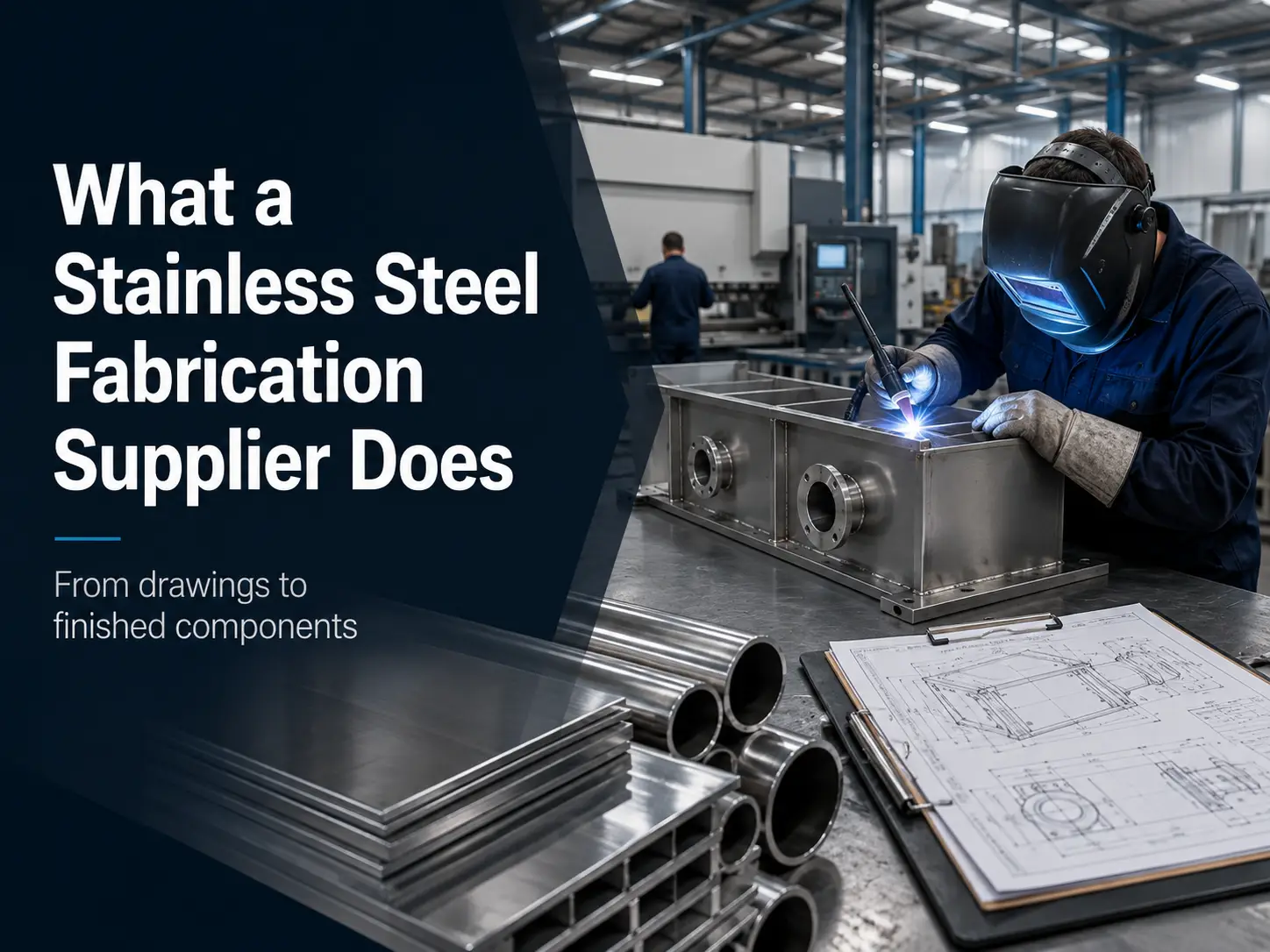
This is different from simply purchasing stainless steel sheets, tubes or standard profiles. In architectural and interior fabrication, the supplier must turn design information into components that can actually be manufactured, transported, assembled and installed.
A typical fabrication scope may include:
- Reviewing PDF, CAD, DWG or shop drawings.
- Confirming stainless steel grade and thickness.
- Identifying visible and concealed surfaces.
- Checking bends, returns, joints and fixing access.
- Confirming hairline, brushed, satin, mirror or decorative finishes.
- Producing repeated components according to approved drawings.
- Checking critical dimensions before packing.
- Inspecting appearance and finish direction.
- Protecting completed components for transportation.
- Preparing project labels and packing information where required.
For a Thai contractor or procurement buyer, this means supplier evaluation should begin with technical information rather than a generic request such as “please quote stainless steel work.” A meaningful quotation requires a defined production scope.
Why Thailand Projects Need More Than a Low Fabrication Price

Custom stainless steel may be used in very different environments across Thailand. A decorative lobby trim inside an air-conditioned Bangkok hotel does not have the same exposure conditions as an exterior railing near a coastal resort in Phuket. A shopping mall feature wall, bathroom frame, villa railing and restaurant cabinet also require different approaches to material selection, finish, fabrication and maintenance.
The supplier therefore needs enough project information to distinguish between applications instead of applying one specification to every stainless steel component.
Bangkok Commercial and Interior Projects
Commercial buildings, hotels, retail stores, restaurants, offices and luxury interiors in Bangkok may use stainless steel together with stone, glass, timber, aluminum, lighting systems and other architectural finishes.
In these applications, visual coordination can become as important as basic fabrication. A narrow stainless steel profile may appear simple in an elevation drawing until the fabrication team examines its returns, fixing tabs, concealed screws, wall interfaces and connection with adjacent finishes.
These details should be resolved before cutting and bending begin.
Phuket and Coastal Applications
Coastal environments require additional attention to material selection, detailing, finish and maintenance. Chloride exposure can make conditions more demanding, so stainless steel grade should be selected according to the actual installation environment rather than simply because the project is located in Thailand.
An indoor decorative frame protected from direct exposure and an exterior architectural component close to the coast should not automatically receive the same material specification.
Pattaya Hospitality and Residential Projects
Hospitality, residential and commercial developments in Pattaya may involve a combination of interior decorative stainless steel and exterior applications. Each zone should be evaluated separately according to moisture, chloride exposure, cleaning methods and project specifications.
Using one material grade or one finish specification across every area without considering the environment can create unnecessary cost in some locations and inadequate performance in others.
Hotels, Resorts and Luxury Villas
Hospitality projects often combine many stainless steel items within the same design language. A project may include wall cladding, railings, shower frames, decorative trims, mirror frames, partitions, wine cabinets and custom architectural details.
The procurement challenge is not only producing one attractive sample. It is maintaining material, color, finish direction, geometry and installation compatibility across many components.
Stainless Steel Grades for Projects in Thailand
Thailand projects should not select stainless steel 304 or 316 using a simple country-based rule. The appropriate grade depends on environment, chloride exposure, moisture, project specification, cleaning conditions, detailing, maintenance expectations, budget and the requirements of the responsible architect or engineer.
Stainless steel 316 generally offers greater resistance in chloride-influenced environments, while stainless steel 304 remains suitable for many less aggressive applications. Neither grade should be selected only from appearance or finish name.
Stainless Steel 304
AISI 304 is commonly considered for architectural and interior stainless steel work where environmental conditions are appropriate. Potential applications may include indoor trims, decorative frames, cabinets, wall features, partitions and other components protected from severe chloride exposure.
However, stainless steel 304 should not be described as a material that can never stain or corrode. Performance is influenced by exposure, fabrication contamination, surface condition, cleaning, detailing and maintenance.
Stainless Steel 316 and 316L
Stainless steel 316 or 316L may be considered where higher resistance to chloride-related exposure is required. This can be particularly relevant for coastal, marine-adjacent, wet or more aggressive environments.
That does not mean every Thailand project requires 316. A dry interior application and an exposed coastal component should be evaluated differently.
The final choice should follow the project specification and the requirements of the responsible designer, architect or engineer.
Material Grade Is Not the Same as Surface Finish
This distinction is especially important in decorative stainless steel fabrication. Terms such as hairline, brushed, mirror, gold, bronze or black describe a surface appearance or treatment. They do not automatically identify whether the base stainless steel is 201, 304 or 316.
A specification that states only “gold stainless steel” or “brushed stainless steel” therefore leaves important material information undefined.
| Evaluation Point | Stainless Steel 304 | Stainless Steel 316 / 316L |
|---|---|---|
| Typical consideration | Many indoor and less aggressive architectural applications | More demanding environments where additional chloride resistance is required |
| Dry interior use | Often considered, subject to project specification | Can be used but may not be necessary for every application |
| Humid or wet areas | Evaluate actual exposure and cleaning conditions | May provide additional corrosion-resistance margin |
| Coastal exposure | Requires careful project-specific review | Often considered where chloride exposure is more significant |
| Chloride resistance | Lower than 316 | Generally higher than 304 |
| Relative material cost | Generally lower | Generally higher |
| Architectural applications | Interior trims, frames, panels, cabinets and other suitable applications | Wet, coastal or more demanding architectural environments when specified |
| Buyer consideration | Confirm environment, exposure, project specification, finish, cleaning, maintenance and designer requirements before ordering. | |
Custom Stainless Steel Fabrication Capabilities for Thailand Projects
For drawing-based work, useful fabrication capability should not be evaluated only by looking at a machine list. The supplier needs to coordinate multiple production stages so final dimensions, joints, visible surfaces, assemblies and finish remain consistent with the approved information.
Inox Asia operates a custom stainless steel fabrication factory in Foshan, Guangdong, China, supporting drawing-based custom fabrication for project buyers. For Thailand projects, the correct positioning is an overseas direct fabrication supplier serving Thai contractors, architects and procurement teams rather than a factory located in Thailand.
Drawing Review
A drawing can appear complete until the fabrication team begins checking how the product will actually be manufactured.
A bend return may interfere with a fixing. A concealed screw may have no installation access. A visible edge may require a different joint treatment. A component may also need to align with stone, glass, timber or aluminum that has its own installation tolerance.
These details should be clarified before production begins.
CNC Laser Cutting and Cutting
Cutting should follow the approved drawing revision and correctly locate holes, slots, openings and component geometry.
Where many similar pieces are involved, identification becomes important. Components that appear nearly identical may belong to different rooms, floors or elevations.
Bending and Forming
Bending affects final dimensions, returns, edge conditions, stiffness and installation interfaces. Decorative trims frequently require more information than basic overall width and height.
Fabrication drawings should show sections, bend returns, fixing points and critical interfaces where applicable.
Welding
Welding requirements vary significantly between products. A concealed structural frame and a highly visible polished architectural feature may require very different treatment.
For visible decorative stainless steel, completing the weld is only part of the job. The appearance after grinding, blending and polishing can be equally important.
Grinding and Polishing
Grinding removes or blends fabrication marks where required. Polishing then creates the specified final surface condition.
The required treatment should depend on which faces remain visible after installation. Applying the same cosmetic requirement to every concealed surface can increase cost unnecessarily, while failing to identify an important visible face can create rejection later.
Assembly and Trial Fitting
Some products contain several parts that must connect together accurately. Assembly or trial fitting may be useful where appropriate to identify interference before packaging.
The need for trial assembly should be defined according to the product and project rather than treated as a mandatory step for every fabricated item.
Surface Finishing
Hairline, brushed, mirror and decorative finishes should be controlled as project specifications. Grain direction, visible faces, sample references and acceptable appearance should be confirmed before final finishing.
Interior contractors managing multiple architectural finishes can also review stainless steel fabrication for interior contractors for additional sourcing considerations.
Have a PDF, DWG, BOQ or shop drawing for a project in Thailand? Send the current files for fabrication review so missing production information can be identified before quotation.
From Drawing to Finished Stainless Steel Product
There is no single workflow that applies to every stainless steel product. A decorative trim, railing, wall panel and custom cabinet require different levels of drawing clarification, finishing and assembly.
However, a structured process helps prevent commercial assumptions from becoming manufacturing problems.
- RFQ received: the buyer sends available drawings, BOQ, specifications, quantity and project information.
- Drawing review: geometry, interfaces and missing production details are reviewed.
- Material confirmation: stainless steel grade is confirmed.
- Thickness confirmation: required material thickness is defined.
- Finish confirmation: hairline, brushed, satin, mirror, decorative or other finish is reviewed.
- Technical clarification: unclear joints, fixing details, visible faces and critical dimensions are resolved.
- Quotation: pricing is prepared against the agreed fabrication scope.
- Shop drawing, sample or mock-up approval: completed where required by the project.
- Cutting and forming: approved components are cut and bent.
- Welding and assembly: completed according to product requirements.
- Grinding and finishing: visible surfaces are processed according to the approved specification.
- Inspection: agreed dimensional and visual requirements are checked.
- Protection and packaging: finished components are protected for handling.
- Shipment preparation: packages and component identification are prepared for delivery.
The workflow may change depending on product complexity, quantity, approval requirements and fabrication method.
A practical procurement rule is to freeze critical information before production begins. Changing a finish reference before fabrication is a clarification. Changing it after a large quantity has been completed can become a replacement or rework problem.
Stainless Steel Products for Thailand Projects
A stainless steel fabrication supplier may manufacture many product types, but project buyers should evaluate the fabrication requirements of each application rather than treating the scope as a general catalogue.
A railing, wall panel, shower frame and wine cabinet may all use stainless steel while having completely different requirements for structure, finishing, assembly and installation.
Architectural Stainless Steel
Architectural applications may include:
- Wall cladding.
- Column cladding.
- Decorative panels.
- Feature walls.
- Trim profiles.
- Custom frames.
- Architectural screens.
Large visible stainless steel surfaces require particular attention to panel geometry, reflection, joint layout, edge treatment and consistent finish direction.
For large-format architectural applications, buyers can also review stainless steel honeycomb panels for hotels.
Stainless Steel Railings and Handrails
Railings combine architectural appearance with structural, fixing and installation considerations.
Shop drawings may need to coordinate:
- Post positions.
- Base fixing.
- Handrail joints.
- Glass interfaces.
- Slopes and corners.
- Finish direction.
- Connection with surrounding construction.
See the related guide to stainless steel railing for luxury projects for additional product-specific considerations.
Bathroom and Hospitality Metalwork
Hotels, resorts and villas may use stainless steel for shower frames, partitions, handles, trims, mirror frames and other bathroom details.
Wet-area components should be reviewed for material grade, surface treatment, glass connection, site dimensions, cleaning and installation interface.
For additional information, see stainless steel shower cubicle for projects.
Wine Cabinets and Decorative Cabinets
Custom wine cabinets may combine stainless steel with glass, lighting, shelving, hardware and other components. The metalwork must therefore be coordinated with these interfaces rather than fabricated in isolation.
Buyers working on hospitality, residential and restaurant interiors can review stainless steel wine cabinets for luxury projects.
Stainless Steel Trims
Decorative trims are often small components but highly visible once installed. They may form transitions between stone, glass, timber, ceilings, wall panels or other materials.
Incorrect profile depth, joint position or grain direction can become visible across an entire interior installation.
For ceiling applications, see custom stainless steel ceiling trim for B2B projects.
Custom OEM Components
Some project buyers do not need a standard product. They need components manufactured according to drawings, prototypes or approved samples.
For these orders, quotation should be based on defined geometry, material, finish, quantity, assembly and inspection requirements rather than a generic price for stainless steel fabrication.
Why Surface Finish Control Matters in Architectural Stainless Steel
Surface finish can determine whether a technically correct component is accepted or rejected visually. Architectural stainless steel is viewed under real lighting and next to other materials, often across repeated walls, columns, trims or decorative features.
Grain direction, polishing consistency, weld blending, reflection and handling marks can therefore matter as much as the basic dimensions.
“Brushed Stainless Steel” May Not Be Specific Enough
A specification stating only “brushed stainless steel” can leave several questions unanswered.
- What exact finish reference is required?
- Which direction should the grain run?
- Which surfaces are visible?
- Must adjacent components visually match?
- Is an approved physical sample available?
The same problem applies to the term “hairline.”
Consider a group of vertical lobby trims. If most pieces have vertical grain but several are fabricated with horizontal grain, those pieces may appear visually different under directional lighting even when the material and nominal finish are the same.
This is why grain direction should be shown on drawings where appearance is important.
Mirror Finish Requires Careful Inspection
Mirror surfaces reveal scratches, dents, distortion and uneven transitions quickly.
Buyers should identify visible faces and define suitable inspection requirements before production. Large mirror surfaces can also reflect surrounding walls, lighting and architectural lines, making geometry more noticeable than on a less reflective finish.
Decorative and PVD Color Consistency
Where decorative colors or PVD finishes are specified, physical sample approval can be more reliable than comparing phone photographs.
Camera processing, screen brightness and ambient lighting can make digital colors appear different from the actual material.
If several product families must match visually, the relationship should be communicated before production.
Protective Film Does Not Replace Proper Packaging
Protective film can reduce scratches during production and handling, but it cannot protect against every impact, bend or abrasion caused by poor packaging.
Finished architectural stainless steel still requires appropriate separation, edge protection and structural support during transportation.
Quality Control Before Stainless Steel Products Are Shipped to Thailand
Quality control should compare finished components against agreed acceptance criteria rather than a vague definition of “good quality.” Inspection requirements vary by project, but common checks include material, dimensions, geometry, welding, finish, assembly, quantity, labeling and packaging.
Typical QC considerations may include:
- Material confirmation: verify the required stainless steel grade where specified.
- Dimensions: check critical overall and interface dimensions.
- Hole locations: confirm holes and slots required for installation.
- Bend geometry: inspect returns, angles and profiles.
- Straightness: particularly important for long trims and repeated profiles.
- Alignment: check assemblies and adjoining components.
- Welding: inspect according to the agreed product requirement.
- Weld blending: review visible transitions after grinding or polishing.
- Assembly fit: confirm parts connect correctly where assembly inspection is required.
- Visible surfaces: check dents, scratches and handling marks.
- Surface finish: compare with agreed specification or reference sample.
- Finish direction: confirm grain orientation.
- Decorative color: compare against approved reference where applicable.
- Protective film: confirm required surfaces remain protected.
- Quantity: reconcile components with the order and packing list.
- Component labels: check identification where required.
- Packing: verify components are properly separated and supported.
Acceptance criteria should ideally be agreed during the RFQ, shop drawing or sample approval stage.
Trying to define appearance requirements only after production has been completed can turn quality inspection into a dispute about assumptions.
Packaging Fabricated Stainless Steel for Delivery to Thailand
Finished architectural stainless steel is particularly sensitive to poor handling because cosmetic damage can make a technically functional component unacceptable.
Packaging therefore needs to protect both the geometry and visible surfaces during handling and transportation.
Polished and Mirror Surfaces
Finished faces should be protected from rubbing against other components. Depending on the product, separators, protective film, edge protection or other packing measures may be required.
Long Stainless Steel Trims
Long, narrow profiles can deform if poorly supported.
Packing should therefore be designed around product geometry rather than simply minimizing package size.
Component Identification
Large interior fit-out packages may contain many similar-looking components intended for different rooms, floors or elevations.
Where required by the project, labels can identify components by:
- Floor.
- Room.
- Area.
- Elevation.
- Drawing number.
- Component number.
This can reduce sorting problems when packages are opened at the project site.
Discuss Packing Before Production Is Finished
Packaging should not be left until the final inspection.
If a contractor needs components grouped by floor, packed according to installation sequence or limited to a certain package size because of site access, those requirements may affect identification and production planning.
Freight rates, customs duties, import taxes, HS codes and transit times are not stated here because these depend on current shipment details and should be confirmed for the specific order.
Direct Overseas Factory vs Local Thailand Fabricator vs Trading Company
No sourcing model is best for every project. A local fabricator may be more suitable when dimensions change continuously on site. An overseas direct factory may be effective for finalized drawings and repeat production. A trading company may be useful when buyers need several unrelated product categories consolidated through one sourcing channel.
| Supplier Type | Best For | Customization | Site Flexibility | Batch Production | Main Consideration |
|---|---|---|---|---|---|
| Local Thailand fabricator | Site-driven work, emergency changes and one-off modifications | Often suitable for custom work | High | Depends on supplier capability | Evaluate finish control, technical capability and production scale |
| Overseas direct factory | Finalized drawings, repeated components, OEM and custom packages | High where drawing-based manufacturing is supported | Lower after products are shipped | Suitable for planned repeat production | Drawing control, QC, approvals and packing must be completed before dispatch |
| Trading company | Multi-category sourcing and supplier consolidation | Depends on underlying manufacturer | Depends on sourcing structure | Depends on factory network | Technical communication may pass through an additional layer |
When a Local Fabricator May Be the Better Choice
Local fabrication may be appropriate when final dimensions are still changing, the design requires repeated site adjustment, installation conditions are uncertain or emergency modifications are expected.
Producing tightly dimensioned components overseas before site conditions are finalized can convert a small measurement error into a complete replacement requirement.
When an Overseas Direct Factory May Make Sense
An overseas direct factory may be suitable when:
- Drawings are finalized.
- Components are repeated.
- Batch quantities are required.
- Decorative finish consistency is important.
- OEM manufacturing is required.
- Multiple related stainless steel components need coordination.
- Technical communication with production is valuable.
When a Trading Company May Be Useful
A trading company may be appropriate where buyers need sourcing coordination across many different product categories.
The trade-off is that drawings, finish requirements and technical questions may pass through another party before reaching the manufacturer.
What Determines Stainless Steel Fabrication Cost?
Custom stainless steel fabrication cost depends on much more than material weight. Grade, thickness, dimensions, material utilization, cutting, bending, welding, polishing, decorative finishing, assembly, quantity, tolerance requirements, quality control, packaging and delivery scope can all affect quotation value.
This is why comparing custom architectural stainless steel only by price per kilogram can be misleading.
Important cost factors may include:
- Stainless steel grade.
- Material thickness.
- Sheet, tube or profile type.
- Overall dimensions.
- Material utilization.
- Cutting complexity.
- Number of bends.
- Forming requirements.
- Welding complexity.
- Grinding and weld blending.
- Hairline or brushed finishing.
- Mirror polishing.
- Decorative finishing.
- PVD treatment where applicable.
- Assembly.
- Quantity.
- Prototype or mock-up requirements.
- Critical dimensional requirements.
- Inspection requirements.
- Documentation requirements.
- Protective packing.
- Freight and delivery scope.
- Project schedule.
Price per kilogram alone is usually an incomplete way to compare custom architectural stainless steel quotations.
Two suppliers may quote the same grade and approximate material weight while including very different levels of finishing, assembly, inspection, protection and packaging.
How Thai Buyers Should Compare Stainless Steel Fabrication Quotations
Before comparing total prices, buyers should normalize the technical scope.
Supplier A may include completed assembly, polished visible surfaces and protected packing while Supplier B may have priced only loose fabricated components. Unless material, finish, quantity, QC and delivery scope are equivalent, the total prices cannot be compared accurately.
| Quotation Item | Supplier A | Supplier B | What to Verify |
|---|---|---|---|
| Material grade | _____ | _____ | Is the same stainless steel grade included? |
| Thickness | _____ | _____ | Is the same material thickness specified? |
| Surface finish | _____ | _____ | Is the finish definition equivalent? |
| Finish direction | _____ | _____ | Has grain orientation been included? |
| Welding | _____ | _____ | Are structural and visible weld requirements the same? |
| Weld blending | _____ | _____ | Is cosmetic blending included where required? |
| Assembly | _____ | _____ | Are products supplied assembled or as loose components? |
| Quantity | _____ | _____ | Are both suppliers quoting the same revision and quantity? |
| Inspection | _____ | _____ | Is the QC scope equivalent? |
| Certification | _____ | _____ | Are the same documents required? |
| Protection | _____ | _____ | Are finished surfaces properly protected? |
| Packaging | _____ | _____ | Is packaging appropriate for the product geometry? |
| Delivery scope | _____ | _____ | Where does supplier responsibility end? |
This comparison can reveal why one quotation appears lower. The supplier may genuinely have a more efficient production approach, or the quotation may simply exclude part of the required scope.
What Should You Send for an Accurate Stainless Steel Fabrication Quote?
For an accurate stainless steel fabrication quotation, send the latest drawing revision, dimensions, quantity, material grade, thickness, surface finish, visible faces, critical dimensions, welding or assembly requirements, fixing details, packing requirements, delivery destination in Thailand and required project schedule. Reference photographs are useful, but photographs alone are usually not enough for production pricing.
| RFQ Information | Why It Matters |
|---|---|
| PDF / CAD / DWG drawing | Defines geometry and manufacturing intent |
| Latest drawing revision | Prevents quotation or production from an obsolete version |
| Dimensions | Required for material planning, cutting, bending and fit review |
| Quantity | Affects production planning and quotation |
| Stainless steel grade | Defines the required base material |
| Thickness | Affects material use, stiffness, forming and cost |
| Surface finish | Defines visual processing requirements |
| Finish direction | Controls appearance across adjacent parts |
| Visible surfaces | Identifies areas requiring higher cosmetic attention |
| Critical dimensions | Identifies interfaces where fit is particularly important |
| Welding requirement | Defines structural and appearance expectations |
| Assembly requirement | Clarifies whether products are supplied loose or assembled |
| Fixing details | Shows how the stainless steel connects to the site |
| Installation interface | Identifies relationships with stone, glass, timber, aluminum or structure |
| Prototype requirement | Allows prototype cost and approval sequence to be reviewed |
| Material certificate requirement | Allows documentation requirements to be confirmed |
| Inspection requirement | Defines the required QC scope |
| Packing requirement | Allows surface protection and component identification to be planned |
| Delivery destination in Thailand | Defines the destination for the commercial delivery scope |
| Required schedule | Allows timing requirements to be reviewed during quotation |
Reference images alone are usually not enough for an accurate production quotation.
A photograph rarely defines material grade, thickness, dimensions, internal construction, fixing positions, critical dimensions or acceptable finish requirements.
If your Thailand project already has a drawing, BOQ, specification, sample or preliminary quantity, submit the available information for fabrication review and project quotation.
Common Mistakes When Sourcing Stainless Steel Fabrication for Thailand
Many stainless steel procurement problems begin before production. The following mistakes create uncertainty that may become expensive only after fabrication or installation has already started.
1. Choosing Only by the Lowest Quotation
A lower price is useful only when the technical scope is equivalent. Missing polishing, reduced inspection, excluded assembly or weaker packaging can make the cheapest quotation more expensive after rework or replacement.
2. Sending Reference Photos Without Dimensions
Reference images can communicate appearance but rarely provide enough information for fabrication. Without dimensions, internal details and fixing information, the supplier may be forced to make assumptions.
3. Failing to Identify the Stainless Steel Grade
“Stainless steel” is not a complete material specification. Buyers should confirm the required grade or ask the responsible project team to define it.
4. Leaving Thickness Undefined
Material thickness affects weight, stiffness, forming, welding, construction and cost. It should not be left to commercial interpretation.
5. Using the Wrong Drawing Revision
Revision control becomes critical when consultants, contractors, procurement teams and suppliers exchange multiple drawing versions.
The approved production revision should be clearly identified before fabrication begins.
6. Not Identifying Visible Surfaces
A concealed weld and a lobby-facing weld may require different finishing treatment.
Marking visible surfaces helps the fabrication team understand where cosmetic appearance is critical.
7. Ignoring Finish Direction
Hairline and brushed surfaces can appear inconsistent if grain orientation changes between adjacent components.
8. Approving Decorative Color Only From Phone Photos
Screen settings, camera processing and lighting conditions can alter perceived color.
Physical finish samples are more appropriate for critical decorative color approval.
9. Ignoring Weld Appearance
A drawing may show where two components meet without defining how the joint should look after welding and polishing.
On decorative architectural stainless steel, this can become a major acceptance issue.
10. Skipping a Mock-Up for Critical Decorative Pieces
A sample or mock-up can expose disagreements about color, edge detail, reflection, grain direction or joint treatment before the issue is repeated across a larger production quantity.
11. Starting Production Before Site Dimensions Are Final
This is especially risky where stainless steel components fit between completed stone, glass, ceilings or wall finishes.
A small site dimension change can affect the entire assembly.
12. Ignoring Packaging Requirements
High-quality polishing has little value if finished surfaces are scratched before installation.
13. Forgetting Installation Interfaces
The stainless steel component may connect with glass, stone, timber, tile, aluminum, concrete or another metal assembly.
These interfaces should be shown or clarified before production.
14. Assuming All Stainless Steel Is Equivalent
Grade, thickness, surface condition, fabrication quality, finish and environmental exposure all affect the final result.
A finish name or general visual appearance should not replace a proper technical specification.
Where Custom Stainless Steel Fabrication Is Used in Thailand
Custom stainless steel fabrication can support architectural, hospitality, commercial and residential applications throughout Thailand. The material grade, finish and fabrication method should be selected according to the actual installation rather than applying the same specification to every project type.
Bangkok Hotels
Stainless steel may be considered for lobby cladding, elevator surrounds, trims, railings, restaurant features, decorative screens, mirror frames and other interior architectural details.
Luxury Condominiums
Potential applications include common-area wall features, elevator halls, entrance frames, decorative trims, railings and custom interior components.
Phuket Resorts
Hospitality projects may use stainless steel in guest bathrooms, restaurants, villas, lobbies, railings and architectural features.
Where components are exposed to coastal conditions, material selection should include environmental and chloride considerations.
Pattaya Hospitality Projects
Indoor decorative applications and exposed coastal applications should be assessed separately rather than given one universal material specification.
Shopping Malls
Retail and commercial environments may use stainless steel trims, shopfront elements, wall features, screens, cabinets, column cladding and railing systems.
Retail Interiors
Custom metal fabrication may support display frames, decorative screens, transition trims and branded architectural elements where standard products do not match the design.
Restaurants and Bars
Stainless steel can serve both decorative and functional roles in food-and-beverage projects.
Possible components include bar features, screens, trims, cabinets, wall details and custom architectural frames.
For additional information, see stainless steel fabrication for restaurants.
Luxury Villas
Villas may use custom stainless steel railings, shower frames, mirror frames, trims, partitions, wine displays, cabinets and one-off architectural details.
These applications are technical examples only and do not imply that Inox Asia has supplied any specific Thailand project unless separately documented.
What Architects Should Confirm Before Approving Stainless Steel Fabrication
Architects should evaluate stainless steel beyond the rendered appearance. A design can look visually complete in a 3D model while still requiring decisions about joints, bends, support, fixing access, panel subdivision, reflection and interfaces before it becomes practical to manufacture.
Important approval points include:
- Design intent.
- Joint locations.
- Visible surfaces.
- Concealed surfaces.
- Finish direction.
- Reflection.
- Panel flatness expectations.
- Edge details.
- Corner details.
- Material interfaces.
- Lighting conditions.
- Finish samples.
- Mock-ups where required.
One useful question during architectural review is: what will actually remain visible after installation?
This helps identify where concealed fabrication is acceptable and where a cleaner visual transition is necessary.
What Contractors Should Confirm Before Production
Contractors carry the approved design into actual site conditions. Their focus should therefore include both appearance and installation feasibility.
- Confirm final site dimensions.
- Define installation datums.
- Confirm fixing positions.
- Check fixing access.
- Review site access.
- Coordinate glass interfaces.
- Coordinate stone interfaces.
- Coordinate timber interfaces.
- Coordinate aluminum interfaces.
- Review installation sequence.
- Define component labels.
- Define packing by floor, room or area where required.
- Consider replacement strategy for critical repeat components.
Site conditions should ideally be finalized before overseas production of tightly dimensioned components.
Where this is not possible, contractors may need to consider keeping certain adjustable or final-fit items within the local fabrication scope.
Procurement Checklist Before Placing an Order
Before issuing a stainless steel fabrication purchase order, procurement should confirm that the commercial order and approved technical information describe the same scope.
- Latest approved drawing revision confirmed.
- Material grade confirmed.
- Material thickness confirmed.
- Finish sample approved where required.
- Finish direction marked.
- Visible surfaces identified.
- Critical dimensions highlighted.
- Welding requirements defined.
- Visible joint requirements defined.
- Final quantity confirmed.
- Prototype or mock-up approved where required.
- QC requirement confirmed.
- Required documentation confirmed.
- Packaging method confirmed.
- Component labeling confirmed.
- Delivery destination confirmed.
- Drawing revision frozen before production.
If several of these items remain undefined, the project may be ready for preliminary budget pricing but not yet ready for final production quotation.
When Does a Direct Stainless Steel Fabrication Factory Make Sense for a Thailand Project?
A direct stainless steel fabrication factory can make sense when the project has sufficiently developed drawings, custom or repeated components, defined finishes and quantities that benefit from planned manufacturing.
It is less suitable for work that requires frequent site measurement changes after fabrication has already started.
Direct factory sourcing is particularly worth considering when:
- The project requires custom fabrication rather than standard products.
- Drawings are finalized or close to approval.
- There are repeated components.
- Batch quantities are required.
- Finish consistency is important.
- Several related stainless steel components need coordination.
- OEM or drawing-based manufacturing is required.
- The buyer wants technical communication closer to production.
Inox Asia supports project-based custom stainless steel fabrication through its production base in Foshan, Guangdong, China.
For Thailand projects, Inox Asia should therefore be evaluated as an overseas direct stainless steel fabrication supplier serving Thailand, not as a manufacturer with a factory in Thailand.
This distinction matters because factory location affects technical communication, inspection planning, shipment preparation and the ability to modify components after production.
Choosing a Stainless Steel Fabrication Supplier for Your Thailand Project
A Stainless Steel Fabrication Supplier for Thailand should not be evaluated from quotation value alone. The more useful question is whether the supplier can convert approved project information into repeatable, inspectable and properly protected components without creating avoidable installation problems.
Before placing an order, evaluate the supplier’s ability to understand drawings, confirm material grade and thickness, identify fabrication constraints, control visible finishes, manage critical dimensions, inspect finished work and prepare completed products for transportation.
Technical communication is equally important. Missing information should be raised before production rather than discovered after components have arrived in Thailand.
A local Thailand fabricator may remain the better choice where site dimensions change frequently or significant installation modification is expected. An overseas direct factory becomes more suitable when drawings are controlled, quantities are repeatable, custom fabrication is required and approval criteria can be defined before manufacturing.
If your project currently has a PDF drawing, DWG file, BOQ, shop drawing, sample, specification or estimated quantity, that is enough to begin a technical review.
Send the current revision together with the intended stainless steel grade, thickness, finish, application, quantity and Thailand delivery destination so the fabrication scope can be reviewed before final quotation.
Discuss your Thailand project by sending the available drawing, BOQ or specification for fabrication review and quotation.
Frequently Asked Questions About Stainless Steel Fabrication for Thailand
What does a stainless steel fabrication supplier do?
A stainless steel fabrication supplier converts drawings, specifications, samples or approved project information into finished stainless steel components. Depending on the product, work may include material review, cutting, bending, forming, welding, grinding, polishing, assembly, surface finishing, quality inspection, protection and packing. The exact process depends on the product and project requirements.
Can stainless steel products be fabricated according to our drawings?
Yes. Custom stainless steel products can be fabricated according to drawings when sufficient production information is available. Buyers should provide the latest drawing revision, dimensions, quantity, stainless steel grade, thickness, finish, visible surfaces, fixing details and critical dimensional requirements. Technical clarification may still be required before quotation or production.
Can custom stainless steel products be supplied for projects in Thailand?
Yes. An overseas fabrication factory can manufacture custom stainless steel components for projects located in Thailand, subject to project review, commercial agreement, packing and delivery arrangements. Buyers should distinguish between a supplier serving Thailand and a factory physically located in Thailand. Inox Asia’s fabrication factory is located in Foshan, Guangdong, China.
Should I use stainless steel 304 or 316 in Thailand?
The choice should depend on installation environment, chloride exposure, moisture, project specification, cleaning, maintenance and designer or engineer requirements. Stainless steel 304 may be suitable for many less aggressive interior applications, while 316 or 316L may be considered where higher resistance to chloride-related or more demanding exposure is required.
What information is needed for a stainless steel fabrication quotation?
Send the latest drawing revision, dimensions, quantity, material grade, thickness, surface finish, finish direction, visible surfaces, critical dimensions, welding or assembly requirements, fixing details, inspection requirements, packing requirements, delivery destination and project schedule. Reference photographs are useful but normally do not contain enough information for an accurate production quotation on their own.
Can a prototype or mock-up be produced before mass production?
A prototype, material sample, finish sample or mock-up may be discussed where appropriate to the product and project. The requirement should be included in the RFQ because it may affect quotation, approval sequence and production planning. Critical decorative components can benefit from sample approval before larger-scale fabrication.
How should surface finish consistency be controlled?
Define the finish through an agreed specification or physical sample, mark grain direction, identify visible surfaces and clarify whether adjacent components must match as one visual group. Decorative colors should not be approved only from phone photographs when accurate color matching is important. Surface protection should continue through packaging and transportation.
Can stainless steel products be fabricated for hotels and resorts?
Yes. Custom stainless steel fabrication may be considered for hotel and resort applications such as railings, trims, wall elements, partitions, shower frames, mirror frames, cabinets and other architectural metalwork. Each application should be evaluated separately because an indoor lobby trim, wet bathroom component and exposed coastal railing have different material and fabrication requirements.
Can fabricated stainless steel parts be packed for international shipment?
Yes. Finished stainless steel can be prepared for international delivery using protective film, separators, edge protection, suitable outer packaging and component identification according to product and project requirements. Long profiles and polished surfaces require particular attention because they can be damaged by inadequate support or surface-to-surface contact.
What is the difference between a direct factory and a trading company?
A direct factory manufactures the components and can communicate closer to the production process. A trading company coordinates sourcing through one or more suppliers and may be useful when buyers need several product categories consolidated. Neither model is automatically better. The decision depends on technical complexity, quantity, project management requirements and the buyer’s preferred sourcing structure.
Can you support OEM or ODM stainless steel fabrication?
Drawing-based OEM or ODM stainless steel fabrication can be reviewed according to the product design, material, finish, quantity and commercial requirements. Buyers should provide available drawings, technical specifications and reference samples so the manufacturing scope can be assessed before quotation.
What drawing formats should buyers send?
PDF drawings are useful for technical review and communication, while CAD or DWG files can provide additional production geometry when available. Shop drawings, section details, BOQ documents and physical samples may also be useful. Whatever format is used, buyers should clearly identify the latest revision before quotation and manufacturing.
CONTACT INFORMATION
Inox Asia – Custom Stainless Steel Fabrication
📍 Showroom: No. 06-106, Vinhomes Ocean Park 3 Urban Area, Nghia Tru Commune, Van Giang District, Hung Yen Province, Vietnam
📍 Factory address: No. 10, No. 6 1st Road, Pingsheng Industrial East Zone, Guicheng Street, Nanhai District, Foshan City, Guangdong Province, China
📞 WhatsApp / Zalo: 0386 122 996
📧 Email: [email protected]
Facebook: facebook.com/inoxhengde
TikTok: tiktok.com/@inox.asia
YouTube: youtube.com/@inoxasiacssf