
Stainless Steel Ceiling Trim is a decorative and functional metal finishing profile used around ceiling edges, ceiling joints, recessed ceiling lines, lighting grooves and transition areas between different materials. In modern architectural and interior projects, this detail is often small in size but very visible in the final space.
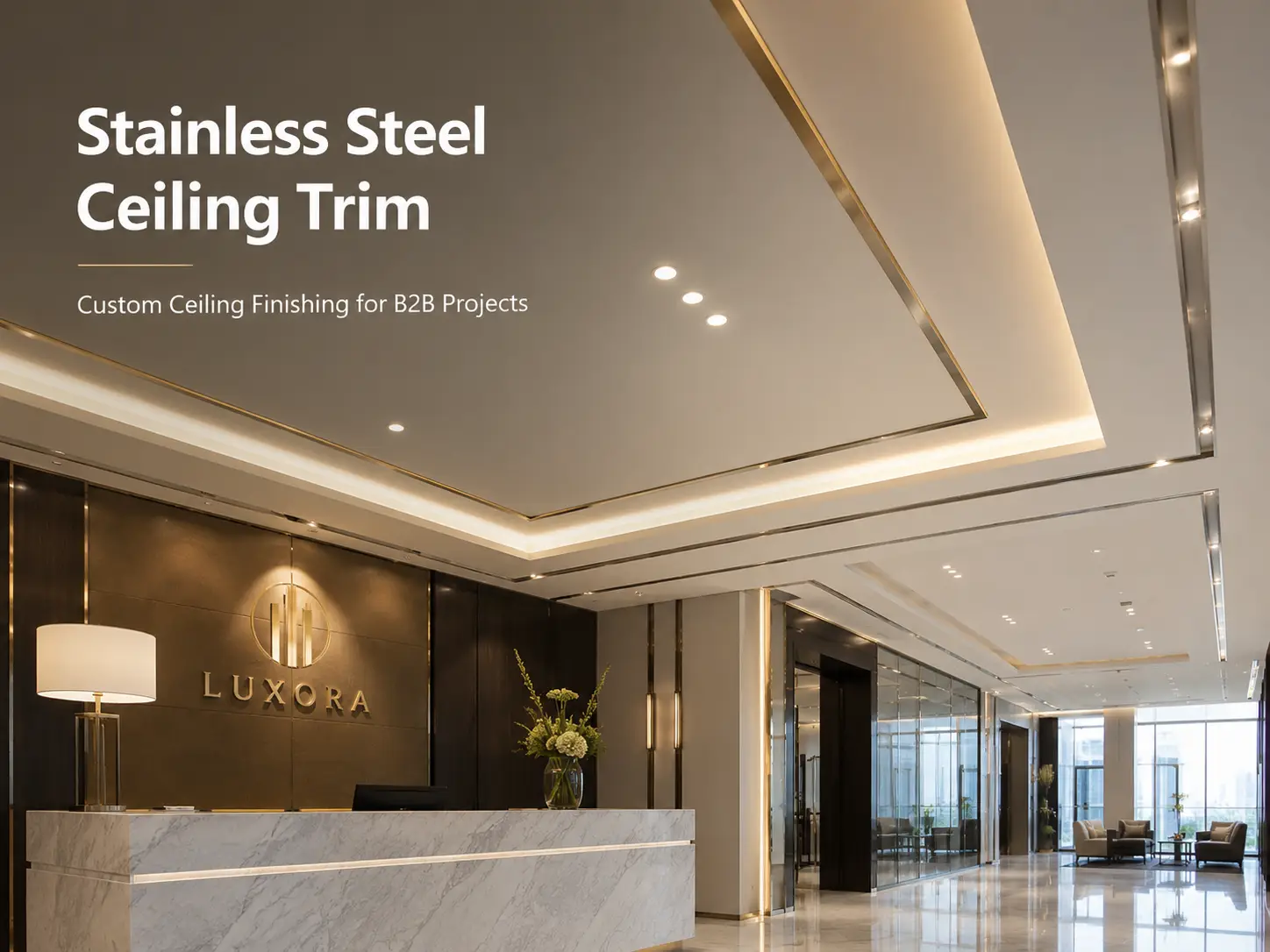
This detail looks small, but it changes the whole ceiling line. A clean stainless steel ceiling edge trim can make a gypsum ceiling, timber ceiling, stone ceiling, glass ceiling or metal ceiling look more complete, more controlled and more premium.
For hotels, villas, showrooms, offices, shopping malls and luxury apartments, the ceiling is not only a flat surface above the room. It is part of the design language. Ceiling lines, lighting details, decorative grooves and material transitions all influence how the space feels. Stainless Steel Ceiling Trim helps create a sharper architectural edge while protecting exposed joints and improving the overall finish.
Compared with ordinary ceiling trim, custom Stainless Steel Ceiling Trim is usually produced according to drawings, samples, photos, site dimensions or project requirements. The profile shape, thickness, width, length, surface finish and PVD color can be discussed before production. This makes it more suitable for project work where consistency, tolerance and visual quality matter.
Inox Asia specializes in custom stainless steel and inox decorative fabrication for B2B architectural and interior projects. As a custom stainless steel fabrication factory, Inox Asia supports project owners, architects, interior design firms, contractors, material dealers, hotels, resorts, villas, showrooms, restaurants, malls, offices and premium apartments.
What Is Stainless Steel Ceiling Trim Used For?
Stainless Steel Ceiling Trim can be used in many ceiling finishing positions. The exact application depends on the ceiling material, design style, lighting plan and installation method.

In real projects, ceiling trim is often used to solve two problems at the same time: decoration and finishing. It improves the appearance of the ceiling line while covering or protecting joints between different materials.
- Ceiling edge trim: Used along ceiling borders to create a clean transition between ceiling and wall.
- Joint covering trim: Used to cover gaps between gypsum board, wall panels, timber panels, stone, glass or metal ceiling panels.
- Decorative ceiling line: Used to create straight metal lines on ceilings for hotels, villas, clubs, restaurants and premium interiors.
- Gypsum ceiling trim: Used with plasterboard ceilings to highlight recessed levels, border lines or special ceiling shapes.
- Wood ceiling edge trim: Used around timber ceilings to protect exposed edges and improve visual contrast.
- Stone or glass ceiling trim: Used where heavier or more premium ceiling materials require a stronger and cleaner finishing detail.
- LED ceiling trim: Used together with indirect lighting, LED grooves or linear lighting systems.
- Commercial ceiling detail: Used in hotel lobbies, corridors, VIP rooms, showrooms, restaurants, villas, offices and shopping malls.
The most common problem is not the trim itself. It is wrong measurement. If the ceiling gap, groove depth or installation tolerance is not confirmed clearly before production, even a beautiful metal ceiling trim can look uneven after installation.
Why Stainless Steel Ceiling Trim Is Used in High-End Projects
High-end projects often need materials that look refined, last longer and coordinate well with stone, glass, wood, wall panels and lighting. Stainless Steel Ceiling Trim is widely used because it can provide a precise line and a premium surface without making the design too heavy.
In hotel lobbies, resort villas, sales galleries and luxury retail stores, ceiling details are usually seen from a distance and under strong lighting. A poor ceiling joint can reduce the perceived quality of the whole space. A well-made stainless steel ceiling profile helps the ceiling look intentional and finished.
Architects and interior designers also use decorative stainless steel trim to control visual rhythm. A brushed stainless steel ceiling trim may create a quiet modern line. A PVD champagne gold trim can add warmth to a luxury lobby. A black titanium line can support a modern commercial or club interior. Mirror stainless steel trim can look impressive, but it needs careful handling on site.
For B2B projects, Stainless Steel Ceiling Trim is not only about appearance. It is also about production consistency. When a project has many corridors, rooms, floors or repeated ceiling details, the factory must control profile size, finish direction, color tone, packing and delivery coordination.
Common Types of Stainless Steel Ceiling Trim
Different ceiling details require different profile structures. Some profiles are used for edge protection, some are used for decorative lines, and some are custom-made for lighting grooves or special installation methods.
Before placing an order, it is better to confirm the ceiling structure and installation purpose. A photo may show the design style, but a drawing shows whether the trim can actually be produced and installed correctly.
U Channel Trim
Stainless steel U channel trim is often used to hold, cover or frame material edges. For ceiling applications, it can be used around glass panels, timber panels, metal ceiling panels or recessed ceiling details.
- Advantages: Clean edge protection, good visual framing and suitable for many ceiling materials.
- Limitations: Inner width and installation clearance must be accurate.
- Suitable projects: Hotels, villas, showrooms, offices and commercial interiors.
- Ordering suggestion: Send the panel thickness, gap size, ceiling material and installation drawing before quotation.
L Angle Trim
Stainless steel L angle trim is commonly used for ceiling edges, corner lines and transition areas between ceiling and wall. It can create a simple and sharp finishing detail.
- Advantages: Simple structure, easy to understand, suitable for many edge finishing positions.
- Limitations: The ceiling and wall line must be straight, otherwise the metal line may reveal uneven installation.
- Suitable projects: Office interiors, corridors, hotel rooms, restaurants and premium apartments.
- Ordering suggestion: Confirm width, height, thickness, length and visible surface direction.
T Profile Trim
Stainless steel T profile trim is usually used to cover joints between two ceiling materials or create a central decorative line. It is especially useful when two panels meet at the same level.
- Advantages: Covers joint gaps neatly and creates a balanced visible line.
- Limitations: The gap width and panel height should be controlled carefully.
- Suitable projects: Showrooms, villas, shopping malls, hotel corridors and office reception areas.
- Ordering suggestion: Provide joint width, visible top width, stem depth and installation method.
Flat Strip Trim
Flat stainless steel strip trim is used as a surface-applied decorative line. It can be installed on ceiling surfaces, border areas or recessed ceiling details when the design needs a clean metal accent.
- Advantages: Minimal appearance, flexible use and suitable for modern interiors.
- Limitations: Surface flatness and adhesive or fixing method should be considered.
- Suitable projects: Retail stores, offices, villas, clubs and restaurants.
- Ordering suggestion: Confirm strip width, thickness, length, finish direction and whether holes or backing treatment are needed.
Custom Ceiling Profile
Custom stainless steel ceiling profile is produced according to project drawings or special design requirements. It may combine bending, welding, polishing, PVD color, slot details or LED-related structure.
- Advantages: Strong design flexibility and suitable for unique architectural details.
- Limitations: Requires clearer drawings, longer communication and sample confirmation for complex profiles.
- Suitable projects: Hotels, resorts, luxury villas, commercial buildings and brand showrooms.
- Ordering suggestion: Send CAD drawings, section drawings, reference photos, finish samples and quantity details.
Decorative Stainless Steel Line Trim
Decorative line trim is often used to create visual rhythm on ceilings. It can be straight, recessed, surface-mounted or combined with other materials.
- Advantages: Adds architectural detail without changing the whole ceiling structure.
- Limitations: Line alignment is critical, especially in long corridors or large public areas.
- Suitable projects: Hotel lobbies, clubs, restaurants, sales centers and premium apartments.
- Ordering suggestion: Confirm installation length, connection method and color consistency before production.
PVD Stainless Steel Ceiling Trim
PVD stainless steel ceiling trim is selected when the project requires colors such as champagne gold, brushed gold, mirror gold, black titanium, rose gold, copper or bronze. PVD coating is often used in decorative metalwork because it can create stable decorative colors when properly specified and handled.
- Advantages: Rich color options, premium visual effect and strong design coordination.
- Limitations: Color should be confirmed with a physical sample, especially for large projects.
- Suitable projects: Hotels, villas, showrooms, clubs, restaurants and luxury retail stores.
- Ordering suggestion: Confirm color sample under real project lighting before bulk production.
Brushed Stainless Steel Ceiling Trim
Brushed stainless steel ceiling trim gives a soft linear texture. It is often preferred in office interiors, modern hotels and commercial buildings because it looks clean without being too reflective.
- Advantages: Modern appearance, easier to maintain than mirror finish and suitable for many interiors.
- Limitations: Brushing direction should be consistent across all pieces.
- Suitable projects: Offices, hotel corridors, shopping malls and premium apartments.
- Ordering suggestion: Confirm hairline or brushed direction before production and packing.
Mirror Stainless Steel Ceiling Trim
Mirror stainless steel trim creates a bright and reflective effect. It can make ceiling details look more luxurious, especially when used with lighting, stone and glass.
- Advantages: High visual impact and suitable for luxury interiors.
- Limitations: Mirror finish shows fingerprints, dust and scratches more easily.
- Suitable projects: Hotel lobbies, VIP rooms, clubs, showrooms and decorative feature ceilings.
- Ordering suggestion: Keep protective film during installation and avoid using it in areas with frequent contact if maintenance is difficult.
Suitable Stainless Steel Materials for Ceiling Trim
The material choice for Stainless Steel Ceiling Trim should be based on project environment, budget, design requirement and expected durability. It is not always correct to choose the most expensive material. It is more important to choose the right material for the right position.
Stainless steel is widely used in architectural metalwork and building materials because it can offer a clean appearance, corrosion resistance and strong decorative value when selected properly.
Stainless Steel 201
For indoor decorative applications, stainless steel 201 may be considered depending on project requirements, budget and environment. It is often discussed for interior ceiling trim where the environment is dry and the decorative requirement is the main priority.
However, stainless steel 201 should be reviewed carefully if the project is in a humid area, coastal location or environment with higher corrosion risk. The final material selection should be confirmed before production.
Stainless Steel 304
Stainless steel 304 is commonly considered for interior and architectural decorative applications because it offers better corrosion resistance than 201 in many environments. For hotels, villas, commercial buildings and premium interiors, 304 is often discussed when the project needs better long-term performance.
For ceiling trim in humid areas, kitchens, bathrooms, spa areas, coastal villas or semi-open environments, stainless steel 304 may be more suitable depending on project requirements.
Stainless Steel 316
Stainless steel 316 may be discussed for special environments, especially coastal areas, high-humidity spaces or projects with higher corrosion resistance requirements. It is not always necessary for normal indoor ceiling trim, but it can be considered when the environment is more demanding.
Material grade, thickness and surface finish should be confirmed based on the actual installation area. For B2B project orders, the factory and client should review environment, budget and technical requirements together before final confirmation.
Surface Finishes and Colors
The finish is one of the most important decisions when ordering Stainless Steel Ceiling Trim. In real projects, the finish sample matters more than the catalog image. Lighting, ceiling height, wall color, stone texture and surrounding materials can change how the trim looks after installation.
PVD coating can be used for decorative stainless steel colors such as champagne gold, brushed gold, mirror gold, black titanium, rose gold, copper and bronze. The exact color should be confirmed by physical samples when color consistency is important.
- Hairline finish: Suitable for modern hotels, offices and commercial interiors. It gives a clean linear texture and is usually easier to coordinate with wall panels and stone.
- Brushed finish: A practical choice for ceiling lines that need a soft reflection. It is suitable for office interiors, corridors and premium apartments.
- Mirror finish: Suitable for luxury lobbies, VIP rooms and showrooms. Mirror finish looks beautiful, but it needs careful handling on site.
- Sandblasted finish: Suitable for projects that need a softer matte appearance and less reflection.
- Anti-fingerprint finish: Useful for decorative stainless steel surfaces where cleaning and handling are important. Availability should be confirmed based on finish and color.
- PVD champagne gold: Warm and elegant, often used in hotels, villas and restaurants.
- PVD brushed gold: Suitable for luxury but not overly reflective interiors.
- PVD mirror gold: Strong visual effect for lobbies, clubs and premium retail stores.
- Black titanium: Suitable for modern commercial interiors, clubs, restaurants and showrooms.
- Rose gold: Used in boutique hotels, beauty spaces, villas and decorative interiors.
- Copper and bronze: Suitable for warm luxury interiors, restaurants and classic-modern spaces.
- Silver: Clean, simple and suitable for offices, commercial buildings and modern apartments.
- Custom colors: Can be discussed based on project requirements, finish samples and production feasibility.
For hotels, champagne gold, brushed gold, bronze and hairline stainless steel are often selected because they match stone, wood and warm lighting. For showrooms, mirror gold, black titanium and high-contrast finishes can help strengthen brand identity. For villas, brushed gold, rose gold, copper or bronze may create a more customized feeling.
For easier maintenance, brushed, hairline or satin-like finishes are usually more practical than mirror surfaces. Mirror finish can be impressive, but it should be protected during transport and installation.
Factory Fabrication Process
A clear fabrication process helps project buyers reduce mistakes and control production quality. Custom Stainless Steel Ceiling Trim requires coordination between design, material selection, surface finish and site installation conditions.
At Inox Asia, custom inox ceiling trim orders can be discussed based on drawings, samples, project photos, reference designs, site dimensions and quantity requirements.
- Receive project requirements, drawings, samples or reference photos: The client sends profile drawings, ceiling section drawings, product photos, finish references, dimensions and quantity.
- Review application area and installation environment: The team checks whether the trim is used for gypsum ceiling, timber ceiling, stone ceiling, glass ceiling, LED groove, wall-ceiling joint or decorative ceiling line.
- Confirm stainless steel grade: Stainless steel 201, 304 or 316 can be discussed based on environment, budget and project requirements.
- Confirm profile shape, size, thickness and length: Width, height, thickness, length, bending angle, tolerance and installation clearance are reviewed before quotation.
- Select surface finish and PVD color: Hairline, brushed, mirror, sandblasted, anti-fingerprint and PVD colors can be selected according to design needs.
- Make quotation: Price is calculated based on material, size, thickness, finish, quantity, fabrication complexity, packing and delivery requirements.
- Confirm sample or finish reference if needed: For large projects, physical samples help confirm color, texture and surface direction before bulk production.
- Cutting, bending, welding and polishing: Production may include cutting, bending, forming, welding, grinding, polishing and surface treatment depending on the profile.
- Quality checking: Key points include dimension, surface quality, color consistency, finish direction, edge condition and packing protection.
- Packing for project delivery: Proper packing helps protect the surface during transportation and site handling.
- Delivery support: B2B orders, OEM/ODM orders and project orders can be coordinated according to project requirements.
How to Choose Stainless Steel Ceiling Trim for Your Project
Choosing the right Stainless Steel Ceiling Trim is not only about selecting a beautiful color. A good ceiling trim should match the ceiling structure, installation method, lighting design and project budget.
For architects and contractors, the safest method is to start from the actual installation position. Once the application is clear, the profile, material, finish and thickness can be selected more accurately.
- Identify the installation position: Is the trim used for ceiling edge, joint covering, decorative line, LED groove or material transition?
- Choose the correct profile: U channel, L angle, T profile, flat strip or custom profile should be selected based on ceiling structure.
- Check material thickness: Thickness affects strength, appearance, bending quality and cost. It should be confirmed before production.
- Select a finish that matches the design style: Hairline and brushed finishes are modern and practical. Mirror and PVD colors are more decorative.
- Consider lighting and reflection: Strong lighting may make mirror trim look brighter but may also reveal scratches or uneven installation.
- Calculate length, quantity and wastage: Long corridors and repeated ceiling lines should be measured carefully.
- Review technical drawings: Drawings help confirm profile size, gap tolerance, installation clearance and fixing method.
- Make color samples for large projects: If the project requires high color consistency, sample confirmation is strongly recommended.
A ceiling line can look perfect in a rendering, but the site condition decides the final result. That is why measurement, tolerance and finish confirmation are important before mass production.
Common Mistakes to Avoid When Ordering Stainless Steel Ceiling Trim
Many project issues happen before production, not during production. If the information sent to the factory is incomplete, the quotation may be inaccurate and the final product may not fit the site.
The most common problem is ordering by image only. A reference photo can show the design direction, but it cannot replace dimensions, drawings and material details.
- Choosing only by image without clear dimensions: A photo cannot confirm width, height, thickness, gap size or installation method.
- Selecting the wrong thickness: Too thin may look weak or deform easily; too thick may increase cost or make bending more difficult.
- Not checking PVD color under real lighting: Gold, bronze, copper and black titanium can look different under warm, neutral or cool lighting.
- Ignoring installation gaps: The trim must fit the actual ceiling structure and joint clearance.
- Using mirror finish in high-contact areas without protection: Mirror finish can show scratches and fingerprints more clearly.
- Not confirming tolerance: Tolerance should be discussed before production, especially for long ceiling lines and repeated profiles.
- Not sending clear drawings or samples: The factory needs accurate information to quote and produce correctly.
- Ordering too close to project deadline: Custom stainless steel ceiling trim may need sample confirmation, production time, packing and delivery coordination.
Comparison with Other Ceiling Trim Materials
Stainless Steel Ceiling Trim is not the only option for ceiling finishing. Aluminum, PVC, wood and painted metal are also used in different projects. The best choice depends on design level, budget, durability requirement and customization needs.
The table below gives a practical comparison for project buyers, architects and contractors.
| Criteria | Stainless Steel Ceiling Trim | Aluminum Trim | PVC Trim | Wood Trim | Painted Metal Trim |
|---|---|---|---|---|---|
| Appearance | Premium, clean, architectural and suitable for luxury interiors | Modern and lightweight, but may look less premium depending on finish | Simple and economical | Warm and natural | Depends on paint quality and surface preparation |
| Durability | Good when the right stainless steel grade and finish are selected | Good for many interior uses | Lower durability for high-end or heavy-use projects | Can be affected by moisture and deformation | Paint may chip or fade depending on environment |
| Customization | High, can be made by drawings, samples and project dimensions | Moderate to high depending on profile and supplier | Limited for custom project profiles | Customizable but may require carpentry coordination | Customizable, but finish options may be limited |
| Surface Finish Options | Hairline, brushed, mirror, sandblasted, anti-fingerprint and PVD colors | Anodized, powder-coated or painted finishes | Basic colors and textures | Natural veneer, paint or stain | Painted or powder-coated surface |
| Maintenance | Relatively easy, but mirror finish needs careful cleaning | Easy in many indoor applications | Easy but may age visually | Needs more care in humid environments | Painted surface may need repair over time |
| Suitable Project Type | Hotels, villas, showrooms, offices, malls and luxury apartments | Commercial interiors, offices and general projects | Budget interiors and simple finishing | Villas, restaurants and warm interior designs | Commercial and general construction projects |
| Cost Level | Medium to high depending on material, finish and complexity | Medium | Low | Medium to high depending on wood type | Medium |
| Best Use Case | Premium ceiling lines, decorative metal details and custom project finishing | Lightweight ceiling edges and simple modern profiles | Cost-sensitive basic ceiling finishing | Warm decorative interiors | Painted architectural details where color matching is needed |
Advantages and Practical Limitations of Stainless Steel Ceiling Trim
Stainless Steel Ceiling Trim offers strong visual and practical advantages, but it also has limitations. A professional project decision should consider both sides before ordering.
This is especially important for B2B buyers because a ceiling trim order may involve many pieces, repeated dimensions, color consistency and project delivery requirements.
Practical advantages include:
- Premium surface appearance suitable for high-end architectural and interior projects.
- Good durability when the correct stainless steel grade and finish are selected.
- Can be customized according to drawings, samples, photos and site dimensions.
- Many surface options, including hairline, brushed, mirror, sandblasted, anti-fingerprint and PVD colors.
- Works well with stone, wood, glass, wall panels, gypsum ceilings and metal ceilings.
- Creates a clear architectural line and improves the final ceiling detail.
- Suitable for OEM/ODM, contractor orders and project-based fabrication.
Practical limitations include:
- Requires accurate measurement before production.
- Mirror finish can show fingerprints and scratches more easily.
- Cost can be higher than PVC or ordinary aluminum trim.
- Poor installation can make ceiling lines look uneven.
- PVD color should be confirmed by sample if the project requires high consistency.
- Complex profiles may require more communication, drawing review and sample confirmation.
Stainless Steel Ceiling Trim is worth considering when the ceiling detail is visible, the project positioning is premium, and the design needs a stronger finishing material than basic PVC or painted trim.
Applications by Project Type
Different projects use Stainless Steel Ceiling Trim in different ways. A hotel may focus on luxury and consistency. A showroom may need strong brand expression. An office may prefer a clean and professional ceiling line.
The finish, profile shape and installation method should be selected according to the actual project environment.
Hotels and Resorts
Hotels and resorts often use Stainless Steel Ceiling Trim in lobbies, corridors, guest rooms, restaurants, ballrooms and VIP areas. Champagne gold, brushed gold, bronze, mirror gold and hairline finishes are common choices depending on the design concept.
For hotel projects, consistency is very important. Long corridors and repeated ceiling areas require stable dimensions, finish direction and color tone. PVD samples should be confirmed before bulk production if the project requires strict color matching.
Luxury Villas
Luxury villas use ceiling trim to create refined transitions between gypsum ceilings, wood ceilings, marble, wall panels and lighting details. Brushed gold, rose gold, copper, bronze and hairline stainless steel can create a warm and customized interior feeling.
Villa projects may have more unique details than commercial projects. Custom stainless steel ceiling profile can be produced according to the designer’s drawing, but site measurement should be checked carefully.
Showrooms and Retail Stores
Showrooms use ceiling details to support brand identity. Stainless steel ceiling finishing detail can connect lighting, display cabinets, walls and product areas. Mirror gold, black titanium, brushed stainless steel and custom PVD colors are often considered.
In retail spaces, lighting is strong. The finish should be checked under real lighting before confirmation. A trim that looks calm in a sample room may look brighter under showroom spotlights.
Office Interiors
Office interiors often use brushed stainless steel ceiling trim, hairline trim or silver stainless steel ceiling profile in reception areas, meeting rooms, corridors and executive spaces. The goal is usually clean, professional and modern.
For offices, overly reflective surfaces may not always be necessary. Brushed and hairline finishes are often easier to maintain and easier to coordinate with glass partitions, wood panels and stone reception walls.
Commercial Buildings
Commercial buildings may use stainless steel ceiling edge trim in public corridors, elevator halls, entrance areas, shopping arcades and shared spaces. The trim should be durable, consistent and easy to coordinate with other building materials.
For large commercial projects, packaging and delivery planning are important. Each profile should be protected properly to reduce scratches during transportation and site handling.
Restaurants and Clubs
Restaurants and clubs often use decorative stainless steel trim with lighting, dark ceilings, mirrors, stone, glass and custom wall panels. Black titanium, mirror gold, bronze, copper and champagne gold can create strong atmosphere.
In these spaces, reflection and lighting should be reviewed carefully. Mirror trim may create a beautiful effect, but it needs careful installation and cleaning.
Premium Apartments
Premium apartments can use Stainless Steel Ceiling Trim in entrance areas, living rooms, corridors, elevator halls and public spaces. Brushed gold, hairline silver, bronze and champagne gold are practical options.
For apartment projects with repeated units or repeated public areas, production consistency is important. Drawings, quantity lists and finish samples should be confirmed before production.
Custom Stainless Steel Ceiling Trim for B2B Projects
Custom Stainless Steel Ceiling Trim is especially suitable for B2B projects because every project may have different ceiling structures, design requirements and installation conditions. Standard profiles may not always fit the design or the site.
Inox Asia can support custom stainless steel decorative trim, stainless steel ceiling trim, stainless steel wall cladding, stainless steel water ripple sheets, stainless steel decorative panels, stainless steel partitions, stainless steel mirror frames, stainless steel wine cabinets, stainless steel shower cabins, stainless steel railings, stainless steel handrails, stainless steel door frames, stainless steel column cladding and stainless steel custom parts.
As a stainless steel decorative trim manufacturer, Inox Asia works with project owners, architects, interior design firms, contractors, material dealers and project buyers who need custom inox fabrication for architectural and interior applications.
Customization may include:
- Profile shape
- Width, height and thickness
- Length and connection method
- Material grade such as stainless steel 201, 304 or 316 if available
- Hairline, mirror, brushed, sandblasted, anti-fingerprint, embossed, water ripple, patterned or PVD color finish
- Champagne gold, mirror gold, brushed gold, black titanium, copper, rose gold, bronze, silver or custom colors
- Packing requirements for project delivery
- OEM/ODM and project order requirements
The company has more than 20 years of experience, 51–100 staff, a 3,000 m² factory size and an annual output value of US$10M–US$50M. Customization can be discussed based on drawings, samples, project dimensions and design requirements.
Stainless Steel Ceiling Trim Price Factors
The price of Stainless Steel Ceiling Trim should not be quoted accurately without drawings or clear dimensions. A simple flat strip and a custom welded ceiling profile may have very different production costs.
For project buyers, the best way to get a realistic quotation is to send drawings, profile sketches, photos, finish references, site dimensions, quantity and delivery requirements.
- Stainless steel grade: 201, 304 and 316 have different material costs and suitable applications.
- Thickness: Thicker material may increase strength and cost. The correct thickness should match the profile and installation requirement.
- Profile shape: U channel, L angle, T profile, flat strip and custom profiles have different fabrication complexity.
- Length and quantity: Longer pieces, large quantities and repeated specifications affect production planning and packing.
- Surface finish: Hairline, brushed, mirror, sandblasted and anti-fingerprint finishes may have different processing requirements.
- PVD color: PVD champagne gold, brushed gold, mirror gold, black titanium, copper, rose gold and bronze should be quoted based on actual finish requirements.
- Fabrication complexity: Cutting, bending, welding, polishing, special angles and custom structures affect cost.
- Packaging requirements: Project packing, protective film, labeling and export packing may influence the final quotation.
- Project delivery requirements: Delivery location, schedule and order arrangement should be discussed before confirmation.
- Sample confirmation: Large projects may require samples or finish references before mass production.
- Installation environment: Indoor, humid, coastal or special environments may affect material selection.
For accurate pricing, send your project information to Inox Asia stainless steel fabrication. The team can review the application and provide a quotation based on actual requirements.
How to Order Custom Stainless Steel Ceiling Trim from a Factory
Ordering from a stainless steel fabrication factory is different from buying standard retail trim. The factory needs technical information to understand what should be produced, how it should be finished and how it will be installed.
To reduce communication time, prepare the following information before quotation:
- Drawings or CAD files
- Profile sketches
- Product photos or reference images
- Finish references or color samples
- Site dimensions
- Required material grade
- Thickness requirement if already specified
- Quantity and total length
- Project location
- Required delivery time
- Packing or labeling requirements
- OEM/ODM requirements if applicable
If you do not have a complete drawing, you can still send photos, sketches and site measurements first. The factory can discuss possible production methods based on the available information. However, final production should be confirmed with clear dimensions and technical details.
For project orders, contact Inox Asia to discuss custom inox fabrication for projects. Sending accurate information at the beginning helps improve quotation accuracy and reduce production risk.
Project Checklist Before Production
Before producing Stainless Steel Ceiling Trim in bulk, project buyers should check all key details. This step is simple, but it can prevent many expensive mistakes.
Use the checklist below before confirming mass production.
- Has the installation position been confirmed?
- Has the profile shape been approved?
- Are width, height, thickness and length clearly shown?
- Has the stainless steel grade been confirmed?
- Has the surface finish been selected?
- Has the PVD color sample been approved if needed?
- Has the finish direction been confirmed?
- Has the installation gap been checked?
- Has the tolerance been discussed?
- Has the quantity and wastage been calculated?
- Has packing protection been confirmed?
- Has the project delivery schedule been reviewed?
Is Stainless Steel Ceiling Trim Worth It for Your Project?
Stainless Steel Ceiling Trim is worth it when the project needs a clean, premium and durable ceiling finishing detail. It is especially valuable in spaces where ceiling lines are visible and design quality affects the overall impression.
For a budget project, PVC or simple aluminum trim may be enough. For hotels, villas, showrooms, offices, malls and premium apartments, stainless steel trim can create a stronger visual result and better material coordination.
The key is to use it in the right place. A well-designed stainless steel ceiling finishing detail can make the ceiling look more refined. A poorly measured one can create alignment problems. The product itself matters, but the drawing, measurement, sample confirmation and installation quality matter just as much.
Contact Inox Asia for Custom Stainless Steel Ceiling Trim
If you are working on a hotel, villa, showroom, office, commercial building, restaurant, mall or premium apartment project, you can send your drawings, photos, profile sketches, finish references, site dimensions and quantity for quotation.
Inox Asia supports custom Stainless Steel Ceiling Trim, decorative stainless steel trim, architectural stainless steel trim and custom inox fabrication for B2B projects.
Inox Asia – Custom Stainless Steel Fabrication
Showroom: No. 06-106, Vinhomes Ocean Park 3 Urban Area, Nghia Tru Commune, Van Giang District, Hung Yen Province, Vietnam
Factory: No. 10, No. 6 1st Road, Pingsheng Industrial East Zone, Guicheng Street, Nanhai District, Foshan City, Guangdong Province, China
WhatsApp / Zalo: 0386 122 996
Email: [email protected]
Website: https://inox.asia/
FAQ About Stainless Steel Ceiling Trim
1. What is Stainless Steel Ceiling Trim?
Stainless Steel Ceiling Trim is a decorative and functional metal profile used to finish ceiling edges, cover joints, create ceiling lines and improve the appearance of ceiling details in architectural and interior projects.
2. Where can Stainless Steel Ceiling Trim be used?
It can be used in hotel lobbies, villas, showrooms, offices, restaurants, clubs, shopping malls, corridors, premium apartments and commercial buildings. Common applications include ceiling edge trim, wall-ceiling joint trim, gypsum ceiling trim and decorative line trim.
3. Can Stainless Steel Ceiling Trim be customized?
Yes. Custom Stainless Steel Ceiling Trim can be produced according to drawings, samples, reference photos, profile sketches, site dimensions and project requirements.
4. Which finish is best for ceiling trim?
The best finish depends on the project style. Hairline and brushed finishes are practical for modern interiors. Mirror finish creates a luxury effect but needs careful handling. PVD colors such as champagne gold, brushed gold, black titanium, copper and bronze are suitable for decorative projects.
5. Is stainless steel 304 necessary for ceiling trim?
Stainless steel 304 is often considered for better corrosion resistance, especially in humid or higher-end environments. For dry indoor decorative applications, stainless steel 201 or 304 may be discussed depending on project requirements and budget.
6. What information is needed for quotation?
For quotation, it is helpful to send drawings, profile sketches, product photos, finish references, site dimensions, material requirements, thickness, quantity, project location and required delivery time.
7. Is PVD stainless steel ceiling trim suitable for hotels?
Yes. PVD stainless steel ceiling trim is commonly used in hotels because it offers decorative colors such as champagne gold, brushed gold, mirror gold, bronze and black titanium. For large hotel projects, color samples should be confirmed before mass production.
8. How do I choose the right profile size?
The right profile size depends on the ceiling structure, joint width, material thickness, installation gap and visible design line. Drawings or site measurements should be reviewed before production.
9. Can Inox Asia produce according to drawings?
Yes. Inox Asia can discuss custom stainless steel ceiling trim production based on drawings, samples, photos, project dimensions and design requirements for B2B project orders.
10. What affects the price of custom stainless steel ceiling trim?
Price is affected by stainless steel grade, thickness, profile shape, length, quantity, surface finish, PVD color, fabrication complexity, packing requirements, delivery requirements, sample confirmation and installation environment.
stainless steel ceiling trim, custom stainless steel ceiling trim, decorative stainless steel trim, stainless steel ceiling edge trim, stainless steel ceiling profile, metal ceiling trim, PVD stainless steel trim, brushed stainless steel ceiling trim, mirror stainless steel trim, stainless steel trim for interior projects, ceiling trim for hotels, ceiling trim for villas, ceiling trim for commercial buildings, architectural stainless steel trim, stainless steel fabrication factory, custom inox ceiling trim, inox decorative trim, stainless steel ceiling finishing detail, stainless steel U channel trim, stainless steel L angle trim, stainless steel T profile trim, stainless steel flat strip trim, custom stainless steel fabrication, inox ceiling profile, decorative metal ceiling trim, stainless steel trim manufacturer, inox fabrication for projects, PVD champagne gold stainless steel trim, brushed gold ceiling trim, black titanium stainless steel trim
CONTACT INFORMATION
Inox Asia – Custom Stainless Steel Fabrication
📍 Showroom: No. 06-106, Vinhomes Ocean Park 3 Urban Area, Nghia Tru Commune, Van Giang District, Hung Yen Province, Vietnam
📍 Factory address: No. 10, No. 6 1st Road, Pingsheng Industrial East Zone, Guicheng Street, Nanhai District, Foshan City, Guangdong Province, China
📞 WhatsApp / Zalo: 0386 122 996
📧 Email: [email protected]
Facebook: facebook.com/inoxhengde
TikTok: tiktok.com/@inox.asia
YouTube: youtube.com/@inoxasiacssf