
A multi-million dollar coastal development can quickly turn into a maintenance liability if the architectural metalwork bleeds rust within its first eighteen months of exposure. We see this scenario frequently when procurement directors or general contractors rely on standard off-the-shelf products rather than engineered solutions. Salt spray, high humidity, and aggressive UV exposure act relentlessly on exterior metals. Detailing Custom Stainless Steel Railing for Resorts requires zero margin for error regarding material grade, surface topography, and fabrication methodology.
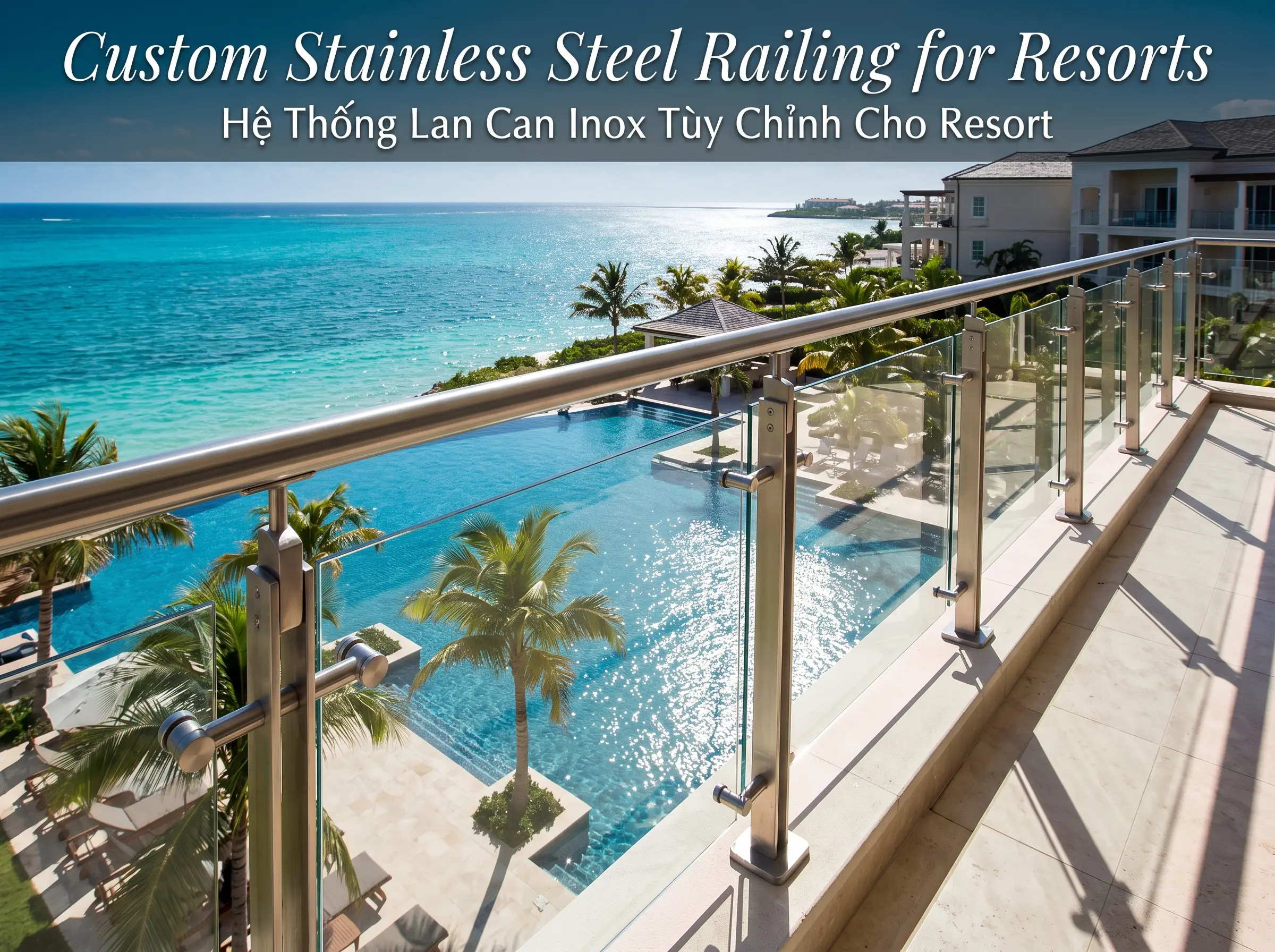
The failure of a balcony balustrade or a pool perimeter railing is not merely an aesthetic issue; it presents severe structural and safety risks under heavy wind loads. Securing a rust-proof railing for coastal resorts demands precise metallurgical specifications, rigorous quality control during the TIG welding process, and a deep understanding of marine environments. We approach every resort project with a strict engineering mindset, analyzing everything from local building codes to the micro-roughness of the final metal polish.
This technical breakdown outlines the critical engineering parameters, fabrication standards, and material science necessary to execute flawless metalwork for high-end hospitality projects. As a direct manufacturing facility handling large-scale commercial contracts, we share the exact blueprints and quality assurance protocols that prevent corrosion and structural failure on oceanfront properties.
The Metallurgy Behind True Marine-Grade Reliability
Understanding the exact chemical composition of the steel you specify dictates the lifespan of the entire installation. Architects frequently specify generic “stainless steel” on preliminary drawings, leaving the project highly vulnerable to substitution by lower-tier contractors. The marine environment demands specific elemental alloying to resist chloride attack.
The primary mechanism of corrosion in coastal areas is pitting. Airborne chloride ions from salt spray break down the passive chromium oxide layer that gives stainless steel its corrosion-resistant properties. Once this microscopic layer is breached, localized galvanic cells form, eating rapidly into the substrate. Standard 304 stainless steel, which contains roughly 18% chromium and 8% nickel, lacks the necessary chemical defense mechanism against continuous chloride exposure.
This is where marine grade 316 stainless steel railing becomes the mandatory baseline. Alloy 316 incorporates 2% to 3% Molybdenum. This specific element drastically increases the Pitting Resistance Equivalent Number (PREN). Furthermore, our facility exclusively specifies 316L (the “L” denoting low carbon, capped at 0.03%). Lower carbon content prevents carbide precipitation during high-temperature TIG welding, eliminating the risk of intergranular corrosion at the weld seams.
Comparing Specifications: 304 vs. 316L for Coastal Applications
To quantify the operational differences between these two common alloys, review the structural and chemical tolerances below. Procurement teams must audit Mill Test Certificates (MTC) to ensure the delivered raw material matches these exact specifications.
| Technical Parameter | Standard 304 Stainless Steel | Marine-Grade 316L Stainless Steel |
|---|---|---|
| Molybdenum Content | 0% | 2.0% – 3.0% (Critical for chloride resistance) |
| Carbon Content (Max) | 0.08% | 0.03% (Prevents weld decay/sensitization) |
| PREN (Pitting Resistance) | ~18-20 (Insufficient for marine) | ~23-28 (Highly resistant to salt spray) |
| Yield Strength (MPa) | 205 MPa | 170 MPa (Slightly more ductile, excellent for cold forming) |
| Ideal Application | Inland hotels, climate-controlled interiors | Oceanfront resorts, pool decks, cruise ship terminals |
| Corrosion in Salt Spray Test | Surface rust visible within 72-120 hours | Passes 1000+ hours ASTM B117 without degradation |
Key Factors to Consider When Specifying Custom Stainless Steel Railing for Resorts
Drafting a specification document for hospitality metalwork requires strict definitions of mechanical loads, environmental exposure, and finishing techniques. Ambiguity in the architectural drawings will inevitably lead to compromised structural integrity and early surface oxidation. You must lock down these technical parameters before releasing the project for tender.
1. Wind Load Engineering and Structural Deflection: Coastal resorts are frequently located in hurricane or typhoon-prone zones. The balustrade system must withstand severe wind pressures, often calculated using ASCE 7-16 or equivalent local building codes. A solid glass balustrade acts as a sail, transferring immense overturning moments to the base connections. We calculate the required section modulus of the posts or base shoe, ensuring deflection remains within the strict limits of L/60 or L/120 under maximum lateral loads. Specify embedment depths and anchor bolt types (e.g., Hilti HIT-RE 500 V3 epoxy anchors) directly in the plans.
2. Surface Roughness (Ra Value) and Finishing: The physical topography of the metal dictates its corrosion resistance just as much as its chemical makeup. A standard #4 brushed finish (hairline finish) contains microscopic peaks and valleys. In a marine environment, salt water pools in these valleys, evaporating and leaving concentrated chloride deposits that initiate pitting. For exterior coastal applications, we mandate a surface roughness (Ra) of less than 0.5 micrometers. If a brushed look is required by the architect, the grain direction must run vertically to facilitate water runoff. Alternatively, a #8 mirror polish provides the ultimate defense, creating a completely flat, non-porous surface.
3. Post-Fabrication Passivation Requirements: Machining, grinding, and handling stainless steel on the factory floor embeds free iron particles into the surface. If left untreated, these exogenous iron particles will rust immediately upon exposure to humidity, a phenomenon often mistaken for the stainless steel itself failing. We subject every fabricated module to a strict chemical passivation process, conforming to ASTM A967. Submerging the welded assemblies in a heated citric acid or nitric acid bath dissolves the free iron and accelerates the reformation of the dense, protective chromium oxide skin.
4. Integrating Resort Architectural Metalwork with PVD Technology: Many luxury resorts require brass, bronze, or matte black aesthetics rather than raw silver steel. Standard powder coating or wet paint will peel and blister in ocean air. To achieve custom colors without compromising marine-grade durability, we utilize Physical Vapor Deposition (PVD). This vacuum-chamber process bonds titanium nitride ions directly into the surface of the 316L steel at a molecular level, providing a permanent, scratch-resistant color that easily withstands salt spray tests.
Deep Dive: 3 Signature Railing Solutions for High-End Resorts
Selecting the right structural model depends heavily on the specific location within the resort footprint. The engineering requirements for a heavy-traffic public lobby differ completely from an intimate, ocean-facing guest room balcony. Below, we dissect the technical specifications, manufacturing processes, and field applications of our three most requested architectural solutions.
Solution 1: Custom Stainless Steel and Glass Balcony Railing
The uninterrupted ocean view is the primary selling point for any luxury coastal property, making heavy-duty frameless or semi-frameless glass systems the standard for exterior balconies. This system typically utilizes a continuous heavy-wall 316L stainless steel base shoe or heavy-duty duplex 2205 core-drilled spigots to clamp the glass panels, topped with a minimalist stainless steel slotted handrail.
- Design Specifications: We utilize 17.52mm or 21.52mm ultra-clear tempered laminated glass. The interlayer is critical; we reject standard PVB (Polyvinyl Butyral) for exposed edges in wet environments, as it absorbs moisture and delaminates. We exclusively specify SentryGlas Plus (SGP) ionoplast interlayers, which provide extreme rigidity and remain pristine even when the glass edges are exposed to driving salt rain.
- Fabrication Highlights: The slotted handrails (U-channels) are CNC-rolled to ensure dead-straight alignment across long balcony runs. The internal rubber gaskets must be perfectly sized to grip the glass without transferring thermal expansion stress from the metal to the glass.
- Pros for Resorts: Zero visual obstruction. Extremely modern aesthetic. Blocks heavy sea winds, creating a comfortable microclimate on the balcony for guests.
- Cons and Challenges: High initial material cost. Requires precise structural engineering for the concrete slab, as the overturning moment on the base shoe is massive during high wind events. Heavy components require significant logistics and lifting equipment on-site.
- Optimal Application: Oceanfront guest room balconies, rooftop infinity pool perimeters, and high-level dining terraces.
- Manufacturer’s Insight: Based on our recent fabrication for a 5-star coastal resort in Southeast Asia, the biggest challenge during the installation phase was managing the slight undulations in the poured concrete slab. We engineered custom adjustable leveling plates beneath the continuous base shoe, allowing the installation teams to achieve perfectly plumb glass panels without using chemical shims, cutting installation time by 30%.
Solution 2: Minimalist Stainless Steel Cable Railing
When the architectural brief calls for an industrial, nautical, or highly transparent aesthetic without the maintenance burden of cleaning large glass panels, cable railing is the optimal specification. This system utilizes a rigid 316L tubular or flat-bar framework, infilled with high-tension horizontal stainless steel wire ropes.
- Design Specifications: The cables are typically 1×19 construction (a single strand of 19 wires) made from 316 stainless steel. 1×19 construction is exceptionally stiff and resists stretching far better than 7×7 or 7×19 flexible cables. Diameters range from 4mm to 8mm depending on the required aesthetic and local code requirements regarding sphere-passage rules (usually requiring gaps to reject a 4-inch sphere).
- Fabrication Highlights: The end-posts carry immense lateral loads. A single run of 10 cables, tensioned to 350 lbs each, applies 3,500 lbs of bending force to the terminal post. We engineer terminal posts using heavy-wall hollow structural sections (HSS) or solid billet 316L steel. Intermediate posts are CNC-drilled with chamfered holes to prevent the steel cable from chafing and breaking during wind vibration.
- Pros for Resorts: Exceptional airflow, making it ideal for tropical climates. Very low maintenance compared to glass. Does not block sightlines and blends seamlessly into natural environments.
- Cons and Challenges: Cables require periodic re-tensioning after the first year of installation as the building settles and thermal cycles cause slight material relaxation. Not permitted by building codes in some jurisdictions if deemed a “ladder effect” climbing hazard for young children.
- Optimal Application: Open-air walkways, mangrove boardwalks, marina access ramps, and perimeter boundary fencing.
- Manufacturer’s Insight: What architects usually appreciate most about this finish is our proprietary hidden-swage tensioning system. Instead of bulky, unsightly turnbuckles exposed on the outside of the posts, we machine internal threading into the terminal posts. The tensioning mechanisms are completely concealed inside the steel tube, maintaining an ultra-sleek, minimalist profile that defines luxury bespoke stainless steel balustrade design.
Solution 3: Curved Stainless Steel Staircase Railing
The grand lobby is the focal point of the guest’s arrival experience. A sweeping, helical staircase clad in highly polished custom metalwork immediately establishes the property’s luxury standard. These are not standardized products; they are highly complex architectural sculptures requiring advanced 3D modeling and multi-axis machining.
- Design Specifications: Continuous, seamless tubular or flat-bar handrails that follow a precise multi-radius mathematical curve. Often paired with curved tempered glass or intricate, laser-cut stainless steel infill panels featuring custom geometric or organic patterns.
- Fabrication Highlights: Cold-rolling 316L stainless steel pipe into a helical spiral is notoriously difficult due to the alloy’s high work-hardening rate and springback. We use CNC 3-roll bending machines monitored by laser measuring tools to achieve exact radii. Every joint must be TIG welded with full penetration, then ground and polished through eight successive grit stages until the weld is 100% invisible.
- Pros for Resorts: Creates an unparalleled, monumental visual impact. Demonstrates high-end craftsmanship. Extremely durable in high-traffic commercial environments.
- Cons and Challenges: Extremely long lead times. Fabrication requires master-level welders and polishers. Shipping large curved sections globally requires custom-built steel shipping frames to prevent distortion during transit.
- Optimal Application: Main reception lobbies, ballroom entrances, and multi-level luxury villas.
- Manufacturer’s Insight: The margin for error in curved metalwork is zero. We require general contractors to conduct a high-density 3D laser scan of the poured concrete stairs. We import that point-cloud data directly into our CAD software. This guarantees that when our fabricated railing modules arrive on-site, they align perfectly with the complex geometry of the physical stairs, eliminating the need for any destructive on-site modifications.
The Fabrication Process: An Inside Look from the Factory Floor
Producing architectural metalwork that survives the harsh realities of a coastal environment requires strict adherence to specialized fabrication protocols. The transition from flat raw sheet metal to a finished, rust-proof railing for coastal resorts is heavily dependent on the skill of the floor technicians and the precision of our machinery.
Every cut begins in our CNC laser department. Using fiber lasers, we slice through heavy 316L plates with tolerances of ±0.1mm. Unlike plasma cutting, fiber lasers introduce minimal heat into the substrate, preventing metallurgical changes at the cut edge. For tubular components, CNC rotary lasers precisely cope the ends of the pipes to ensure zero-gap fitment before welding. A tight joint is critical; large gaps require excessive filler wire, which introduces unnecessary heat and increases the risk of distortion.
The welding phase is where inferior products fail. We employ exclusively Tungsten Inert Gas (TIG) welding. During tube welding, we utilize an Argon back-purging technique. By flooding the inside of the tube with inert Argon gas, we displace all oxygen. This prevents “sugaring” (heavy oxidation and porosity) on the inside of the weld seam. While the outside of a weld can be ground and polished, the inside remains inaccessible; if sugaring occurs, internal corrosion will rapidly eat through the joint from the inside out.
Post-welding, the Heat Affected Zone (HAZ) requires intensive mechanical treatment. The intense heat of the electric arc brings chromium to the surface, leaving the immediate surrounding area depleted and vulnerable. Our finishing teams meticulously grind the welds flat using heavy abrasives, progressively stepping down through 120, 240, 400, and 600 grit ceramic belts. For a mirror polish, sisal wheels and specialized polishing compounds are applied until the surface achieves maximum reflectivity. This seamless finish is not merely aesthetic; by removing all microscopic crevices, we eliminate the physical locations where chlorides can initiate pitting.
Common Mistakes Architects Make in Stainless Steel Railing Design
Even with premium raw materials, structural design flaws can compromise the longevity of a balustrade system. Over the past decade of reviewing tender drawings for commercial stainless steel fabrication, our engineering team consistently identifies several recurring design errors that must be corrected before production.
1. Designing Flat Horizontal Surfaces: Specify a curved or sloped profile for handrails and base tracks. Flat top rails allow standing water, morning dew, and salt spray to pool. Gravity is the most effective defense against corrosion. Water must be forced to run off the metalwork immediately. A simple 5-degree slope on a rectangular handrail drastically increases the maintenance interval.
2. Ignoring Galvanic Corrosion Principles: Architects frequently detail stainless steel railings bolting directly to structural carbon steel embed plates or utilizing aluminum trim components without isolation. When dissimilar metals are in contact in the presence of an electrolyte (like salt-laden moisture), the anodic metal will rapidly corrode. We mandate the use of dielectric isolation materials, such as Delrin washers, neoprene gaskets, or Teflon shims, to physically separate the 316L stainless from any adjacent carbon steel or aluminum framing.
3. Specifying Tight Crevices and Hidden Pockets: Elaborate architectural designs often feature tight overlapping plates, narrow gaps between posts, or decorative sleeves. These narrow spaces create crevice corrosion. Oxygen is required to maintain the passive oxide layer on stainless steel. In tight crevices, water enters, but oxygen is depleted. The local environment becomes highly acidic, and rapid, aggressive localized corrosion occurs. We redesign joints to either be completely open (allowing free airflow and easy cleaning) or continuously welded shut and polished.
4. Misunderstanding Thermal Expansion Kinetics: Stainless steel has a high coefficient of thermal expansion. In a tropical resort environment, a 50-meter straight run of balcony railing subjected to intense afternoon sun will expand significantly. If the architect details the system as a single, rigidly bolted structure, the expansion forces will shear the anchor bolts right out of the concrete slab or cause the steel posts to buckle. We always engineer hidden slip joints and expansion gaps into long continuous handrails to accommodate daily thermal cycling.
Why Partnering with a Direct Manufacturer is Crucial for Large B2B Projects?
Procuring metalwork through layers of middlemen, trading companies, or general architectural hardware suppliers introduces massive risk into a large-scale resort development. When supplying hundreds of meters of custom stainless steel railing for resorts, direct factory engagement is not just a cost-saving measure; it is a critical quality control strategy.
First, direct manufacturers provide absolute supply chain transparency. We control the raw material procurement, allowing us to trace every length of steel back to the original foundry via heat numbers and Mill Test Certificates. If a trading company sources from multiple unverified workshops to fulfill a large order, you will inevitably receive mixed grades of steel, leading to catastrophic patchy rusting across the resort.
Second, the ability to rapidly prototype is essential. Before launching mass production for a 500-room hotel tower, we fabricate a full-scale, physical mockup of the balustrade module. This allows the architect to verify the ergonomics of the handrail, the structural engineer to test the load deflection, and the installation contractor to practice the anchoring process. Modifications at this stage cost pennies; fixing errors during final site installation costs millions.
Finally, direct manufacturing facilitates true value engineering. Because we operate the CNC machines and manage the welding teams, we understand exactly where costs accumulate. If a project is over budget, we can advise the procurement director on structural adjustments—such as increasing post spacing by 150mm and up-sizing the tube wall thickness—which reduces overall material weight, welding time, and polishing labor without compromising the structural code requirements or the visual aesthetic.
B2B FAQ: Sourcing, Fabrication, and Warranty
For procurement directors, quantity surveyors, and lead architects, technical clarity is paramount before issuing a purchase order. Here are the most critical questions addressed by our engineering and factory management teams.
1. What is your standard lead time for custom resort railing production?
Lead times depend on design complexity and total meterage. Generally, after final shop drawing approval, raw material procurement and CNC processing take 2-3 weeks. Assembly, welding, and polishing for a standard 500-meter commercial order require an additional 4-6 weeks. Sea freight and customs clearance vary by destination. We advise allocating a 10-14 week lead time from order confirmation to site delivery for international B2B projects.
2. Can you guarantee the metalwork will not rust in a direct oceanfront environment?
We guarantee the integrity of the material grade and the passivation process. We exclusively use 316L stainless steel with verified Molybdenum content, finished to a Ra <0.5 micrometer and chemically passivated. However, stainless steel is “stain-less,” not stain-proof. A strict, documented maintenance protocol (routine fresh-water washing to remove accumulated salt deposits) must be implemented by the resort’s facilities management to activate any long-term anti-rust warranties.
3. Do you provide localized structural engineering calculations?
We provide comprehensive factory shop drawings detailing all dimensions, material thicknesses, and connection methodologies. While we engineer the systems to meet broad international standards (like IBC or ASCE wind loads), the final structural sign-off and stamping must be completed by a locally registered Professional Engineer (PE) hired by the client, as they hold the legal authority for the specific geological and code requirements of the project site.
4. Can you fabricate from our existing architectural CAD files?
Yes. Our in-house drafting team regularly imports DWG, DXF, and 3D Rhino/SolidWorks files. We conduct a constructability review on your drawings to ensure the designs can be practically welded and polished. We then convert your architectural concepts into detailed manufacturing shop drawings for final sign-off before any steel is cut.
5. How do you handle the global shipping of large, fragile balustrade modules?
Logistics are engineered alongside the product. We design modular systems that maximize the internal volume of standard 20ft or 40ft shipping containers. Finished metalwork is wrapped in protective PE film, cushioned with high-density EVA foam, and securely strapped into custom-built, heat-treated wooden crates or steel transport racks to prevent any shifting or abrasive damage during ocean transit.
6. What quality control documentation accompanies the final delivery?
For high-end B2B contracts, traceability is non-negotiable. With every shipment, we provide a comprehensive QA/QC dossier. This includes the original Mill Test Certificates (MTC) proving the chemical composition of the 316L steel, signed dimension check reports from our quality control managers, photographic evidence of the pre-shipment assembly, and the pass/fail records from internal surface roughness testing.
Securing Your Next Project with Precision Manufacturing
Executing a flawless architectural vision on a hostile coastal site requires more than just good design; it demands a deep understanding of metallurgy, precise fabrication technology, and rigorous quality control. Custom Stainless Steel Railing for Resorts must be treated as highly engineered structural lifelines, not mere decorative accents. By specifying strictly controlled 316L alloys, mandating flawless surface finishes, and partnering directly with an experienced manufacturing facility, developers can ensure their oceanfront investments remain pristine, structurally sound, and stunning for decades. We stand ready to review your blueprints, optimize your specifications, and deliver world-class metalwork directly to your job site.

CONTACT INFORMATION
Inox Asia – Custom Stainless Steel Fabrication
📍 Showroom: No. 06-106, Vinhomes Ocean Park 3 Urban Area, Nghia Tru Commune, Van Giang District, Hung Yen Province, Vietnam
📍 Factory address: No. 10, No. 6 1st Road, Pingsheng Industrial East Zone, Guicheng Street, Nanhai District, Foshan City, Guangdong Province, China
📞 WhatsApp / Zalo: 0386 122 996
📧 Email: [email protected]
Facebook: facebook.com/inoxhengde
TikTok: tiktok.com/@inox.asia
YouTube: youtube.com/@inoxasiacssf